


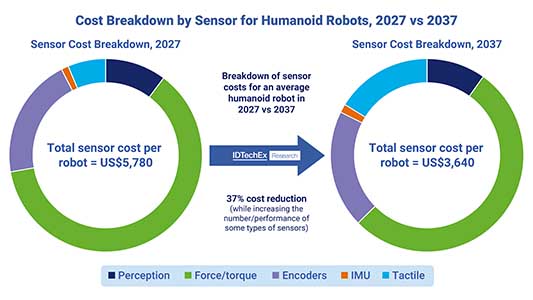
Humanoid robots are transitioning from conceptual prototypes to AI-driven machines suitable for early rollout in commercial and industrial spaces. A major component of this transition is the array of sensors integrated into each robot. As the commercial opportunity for humanoid robotics continues to grow, the new report “Sensors for Humanoid Robots 2027-2037: Technologies, Players, Forecasts” by IDTechEx forecasts that the market for sensors in humanoid robots could reach over US$6.59 billion by 2037 with a CAGR of 21.4%.
Commercial humanoid robot models can differ greatly in the exact sensor arrays used, but there are generally five staple categories for any model: perception sensors, force/torque sensors, encoders, inertial measurement units (IMUs), and (more optionally) tactile sensors. These sensors provide information about the robot’s internal state and external environment, with information from multiple types of sensors combined and processed through sensor fusion to allow the robot to make decisions about its next actions and operate with multiple layers of safety mechanisms.
Perception Sensors and the Intersection with Automotive Autonomy
Perception sensors are a key differentiator between humanoid robot models. The categories covered in “Sensors for Humanoid Robots 2027-2037: Technologies, Players, Forecasts” include depth cameras, lidar, ultrasonic sensors, and mmWave radar. In the current humanoid robot market, there is an ongoing discussion as to whether cameras alone are sufficient for navigation and mapping, or whether lidar is needed for its depth sensing capability and robustness to changing lighting environments. The advantages and limitations of each sensing technology are discussed in this report, along with case studies of humanoid robot designs employing lidars and cameras versus the “pure vision” camera-only route.
It’s also no coincidence that there is significant overlap between the sensors used for humanoid robots and automotive, particularly advanced driver assistance systems (ADAS) and autonomous vehicles. Both systems have similar requirements: to dynamically sense and predict their environment in order to make safe and effective decisions about future actions. Similar technologies and key players can be found supplying both industries, such as Sony, Hesai Technology, Livox, and Ouster.
What complicates this intersection further is the fact that many automotive companies are also developers of humanoid robots, significant investors in humanoid companies, and/or often serve as the first customers for commercial trials of humanoids. Tesla, for example, develops its Optimus humanoid robot while being a high-profile proponent of their use in automotive manufacturing, and both its humanoid robots and autonomous vehicles reportedly use a similar camera-only patented approach to vision sensing and mapping.
Sensors for Movement, Balance, and a Delicate Touch
Every humanoid robot design relies on actuators for movement, with the number of degrees of freedom varying by model. The joints and actuators of humanoid robots require a combination of force sensors, torque sensors, and encoders (position sensors) to operate efficiently. Force and torque sensors provide information about internal strains on the robot as well as external loads and forces from payloads or impacts.
Six-axis force-torque sensors, which measure linear forces and rotational torques in all three dimensions, are typically deployed in the ankles to enhance the robot’s ability to balance, and in the wrists to enable the precise manipulation of objects. However, six-axis force-torque sensors are currently one of the most expensive sensing components for a humanoid robot. This is partly due to a limited supply chain overlap with industries outside robotics, as most other uses of these sensors are in medical or industrial robot arms, where current manufacturers produce them as precision instruments in relatively low annual volumes compared to the amount needed for future humanoid robot deployments.
Finally, tactile sensing is even more varied in terms of sensing technology, with MEMS, capacitive, printed/flexible, optical, and magnetic sensors all being explored in the IDTechEx report on Sensors for Humanoid Robots. Tactile sensors can be deployed in the dexterous hands or grippers of humanoid robots, or more broadly in e-skins that cover larger portions of the body. This makes tactile sensors an area of humanoids that is rife with innovation and a key differentiator between different models and manufacturers.

Overview of the types of sensors deployed in humanoid robots. Image source: IDTechEx.

Market Outlook
Humanoid robots must be equipped with a variety of sensors to plan and execute tasks, operate safely around other robots and people, and navigate around real-world, dynamic environments. A sustainable commercial rollout of humanoid robots will depend on an ecosystem of sensor manufacturers that can scale with the growth of humanoid adoption without creating critical supply chain bottlenecks. The IDTechEx report on Sensors for Humanoid Robots addresses which types of sensors are currently being deployed in humanoid models aimed at high-volume commercial deployment, where they are being manufactured and by whom, and any future trends, potential bottlenecks, or disruptive innovations for each.
For more information on this report, including downloadable sample pages, please visit www.IDTechEx.com/HumanoidSensors, or for the full portfolio of related research available from IDTechEx, see www.IDTechEx.com.