


Introduction
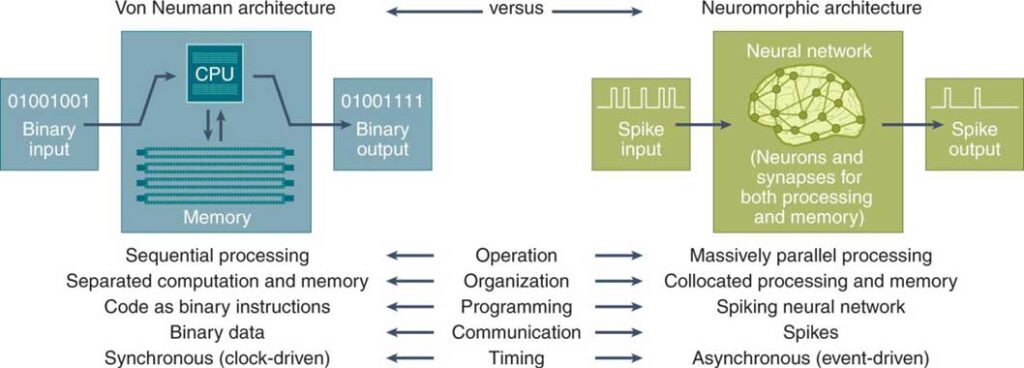
The rapid progression of artificial intelligence (AI) and machine learning (ML) has placed unprecedented demands on computing architectures. Conventional digital processors, constrained by the von Neumann bottleneck—the separation of memory and processing—struggle to deliver the energy efficiency and real-time adaptability required by next-generation intelligent systems. In response, the electronics community is turning toward neuromorphic computing, an innovative paradigm that takes inspiration from the human brain’s structure and operational principles.
At the heart of this transformation lie two pivotal technologies: memresistors (memory-based resistive devices) and neuromorphic devices that leverage them to bring brain-like computation into silicon and beyond. This article explores the fundamentals, device physics, architectures, applications, challenges, and future prospects of memresistors and neuromorphic systems.
Fundamentals of Memresistors
What Is a Memresistor?
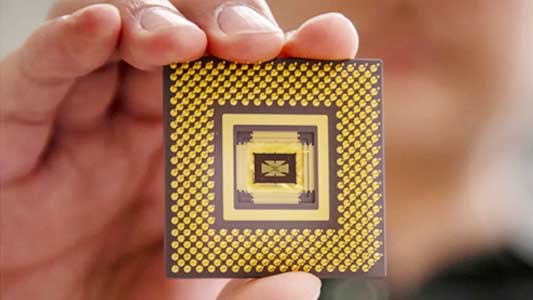
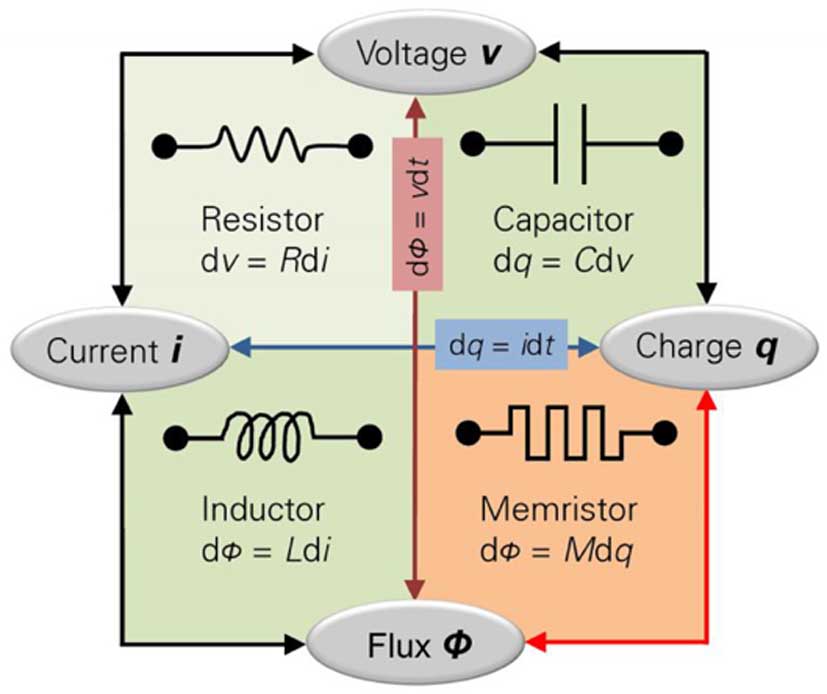
A memresistor—often referred to as a memristor (memory resistor)—is a two-terminal passive electronic component whose resistance changes based on the history of voltage and current that has flowed through it. Importantly, this resistance state is non-volatile; it persists even when the device is powered off.
Leon Chua first theorized the memristor in 1971 as the fourth fundamental circuit element, completing the relationship between charge and magnetic flux. However, practical realizations emerged only in the late 2000s through nanoscale metal-oxide structures.
Working Principle
At the core of memresistor operation is ionic movement and conductive filament formation within a dielectric matrix. In typical metal–insulator–metal (MIM) structures such as TiO₂, HfO₂, or perovskites:
- Low resistance state (LRS) is achieved when ions (e.g., oxygen vacancies) form a continuous conductive path between electrodes.
- High resistance state (HRS) results when this filament dissolves or breaks.
The device’s resistance at any instant reflects its cumulative voltage–current history—effectively “remembering” prior stimuli.
Device Physics & Materials
Ionic Conduction and Switching Mechanisms
Memresistors exhibit two primary switching mechanisms:
- Filamentary switching – Localized formation and rupture of conductive filaments.
- Interface-type switching – Modulation of interfacial barrier heights affecting conduction.
Both processes involve nanoscale ionic dynamics, warranting advanced materials engineering to balance switching speed, endurance, retention, and energy consumption.
Material Systems for Memresistors
Key materials systems include:
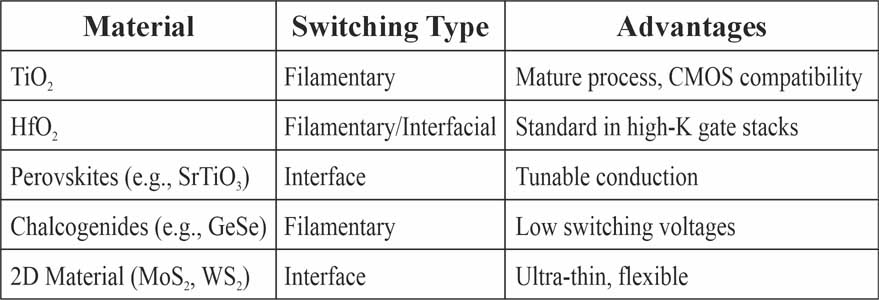
Each material offers different trade-offs between switching threshold voltages, ON/OFF ratios, endurance (number of cycles), and retention time.
Device Architectures
Memresistors can be implemented in diverse architectures:
- Crossbar arrays: Dense 2D arrays of memresistors at electrode intersections—ideal for matrix-vector multiplication in neuromorphic accelerators.
- Vertical stacks: Multiple memristive layers for 3D integration.
- Hybrid CMOS–memristor circuits: Integrating memresistors with logic transistors for adaptive logic.
Neuromorphic Devices and Architectures
What Is Neuromorphic Computing?
Neuromorphic computing refers to hardware inspired by the structure and function of biological neural systems. Rather than separate compute and memory, neuromorphic architectures co-locate storage and processing, enabling massively parallel and energy-efficient computation.
Biological neurons communicate through spikes, and synapses—strengths of connections—adjust through learning. Replicating these principles in hardware is the key objective of neuromorphic engineering.
Why Memresistors?
Memresistors are uniquely suited to neuromorphic systems because:
- Their analog resistance modulation emulates synaptic weights.
- They inherently integrate memory and computation.
- They support non-volatile storage, reducing energy overhead.
By programming memresistor conductance to represent synaptic weights, systems can perform matrix-vector multiplication (MVM)—the core of neural network computation—directly in memory.
Crossbar Arrays as Synthetic Synaptic Networks
In a crossbar architecture:
- Horizontal lines serve as input neurons.
- Vertical lines represent output neurons.
- Memresistors at intersections encode synaptic weights.
Applying voltages along inputs induces current sums along outputs according to Ohm’s and Kirchhoff’s laws. This enables in-hardware MVM with exceptional energy efficiency.
Input → —|— R11 —|— R12 —|— R13 —…
| | |
R21 R22 R23
| | |
R31 R32 R33 … → Output
Where Rij is a memresistor with programmable conductance.
Learning Mechanisms in Memristive Neuromorphic Systems
Spike-Timing Dependent Plasticity (STDP)
STDP is a biologically inspired learning rule where the timing difference between pre- and post-synaptic spikes determines synaptic weight updates. Memristors can naturally exhibit STDP by applying tailored pulse timing and shapes, enabling on-chip learning without centralized training.
Backpropagation and In-Memory Compute
While traditional backpropagation is challenging to implement directly in hardware due to its complexity, memristive crossbars can accelerate its forward propagation and gradient computation. Hybrid approaches combine digital processors with memristive accelerators to enable efficient training.
Neuromorphic Logic and Plasticity Rules
Other plasticity rules, such as:
- Hebbian learning
- Homeostatic plasticity
- Meta-plasticity
Can be implemented using programmable memresistor networks, enabling systems that adapt dynamically to changing stimuli.
Applications of Memristors & Neuromorphic Hardware
Memristors and neuromorphic hardware represent a major shift in computing technology, inspired by the efficiency and adaptability of the human brain. Unlike conventional digital systems that separate memory and processing, memristors combine both functions in a single device, enabling fast, low-power, and brain-like computation. Neuromorphic hardware further extends this concept by implementing neural architectures such as spiking neural networks (SNNs), making it possible to achieve real-time intelligence with minimal energy consumption.

These technologies are becoming increasingly important for next-generation AI, edge computing, robotics, and future memory systems. Below are the key application areas where memristors and neuromorphic computing are creating significant impact.
1. Edge AI and Ultra-Low-Power Inference
One of the most significant applications is in Edge AI, where intelligence is deployed directly on devices rather than relying on cloud processing.
Why it matters:
- Edge devices have limited battery power
- Cloud-based AI introduces latency
- Data privacy requires local processing
Memristor-based neuromorphic processors enable:
- Always-on AI with extremely low energy use
- Event-driven inference for smart sensors
- Real-time decision-making in IoT systems
Applications:
- Smart surveillance cameras
- Wearables and health monitors
- Autonomous drones and robots
- Industrial IoT nodes
2. Non-Volatile Memory Technologies (ReRAM)
Memristors are natural candidates for next-generation non-volatile memories, particularly Resistive RAM (ReRAM).
Key advantages:
- Stores information as resistance states
- Faster switching than Flash memory
- Higher endurance and scalability
- Lower power consumption
Applications:
- Embedded memory for AI chips
- Storage-class memory in data centers
- Persistent memory for edge devices
ReRAM is considered a leading post-Flash memory technology.
3. In-Memory Computing for AI Acceleration
A major challenge in modern computing is the von Neumann bottleneck, caused by constant data transfer between memory and processor.
Memristors enable in-memory computing, where computation occurs directly within memory arrays.
Benefits:
- Reduced energy consumption
- Faster matrix operations
- Efficient deep learning inference
Applications:
- AI accelerators for edge and cloud
- Neural network inference engines
- High-performance computing systems
Memristor crossbar arrays are especially efficient for multiply– accumulate (MAC) operations.
4. Neuromorphic Synaptic Hardware
Memristors naturally emulate biological synapses by adjusting resistance based on activity, enabling synaptic plasticity.
Applications:
- Artificial synapse arrays
- Spiking neural networks (SNNs)
- On-chip learning systems
This is critical for building brain-inspired processors capable of adaptive learning.
5. Brain-Inspired Cognitive Computing
Neuromorphic systems aim to replicate brain-like capabilities such as:
- Learning
- Pattern recognition
- Decision-making
- Adaptation
Applications:
- Cognitive AI processors
- Real-time perception systems
- Autonomous intelligent machines
Such systems can operate with orders of magnitude lower power than GPUs.
6. Robotics and Autonomous Systems
Robots require real-time sensory processing and adaptive decision-making. Neuromorphic hardware enables:
- Fast perception and navigation
- Energy-efficient control systems
- Continuous learning in dynamic environments
Applications:
- Humanoid robots
- Industrial automation
- Autonomous vehicles and drones
Memristor-based synapses improve adaptability and efficiency.
7. Smart Sensors and Event-Driven Processing
Neuromorphic architectures excel at processing event-based data streams.
Applications:
- Event-driven vision sensors
- Low-power audio recognition
- Chemical and environmental monitoring
Smart sensors with embedded neuromorphic processing reduce bandwidth and cloud dependence.
8. Digital Computing and Logic-in-Memory
Memristors are also being explored beyond analog neuromorphic systems, in digital computing.
Applications:
- Logic-in-memory architectures
- Non-volatile digital circuits
- Hybrid CMOS–memristor processors
These approaches improve efficiency by combining memory and logic functions.
9. Security and Hardware Cryptography
Memristors exhibit unique resistance variations that can be used for security primitives.
Applications:
- Physically Unclonable Functions (PUFs)
- Secure key storage
- Anti-tamper memory systems
These are essential for IoT, automotive, and defense electronics.
10. Healthcare and Biomedical Systems
Neuromorphic computing is highly suitable for medical devices due to its low power and real-time capability.
Applications:
- Brain–machine interfaces
- Neural prosthetics
- AI-assisted diagnostics
- Continuous patient monitoring
Memristor-based devices can also model neural disorders for research.
11. Defense and Aerospace Applications
Memristors and neuromorphic systems provide advantages for mission-critical environments:
- Low-power autonomy
- Radiation-tolerant memory
- Secure communication and sensing
Applications:
- Autonomous surveillance drones
- Cognitive radar systems
- Secure battlefield intelligence
12. Future Brain Simulation and AGI Hardware
Long-term research aims to use memristor synapse arrays for:
- Large-scale brain simulation
- Neuromorphic supercomputers
- Cognitive architectures for advanced AI
This represents a future direction toward human-like intelligence in hardware.
Challenges and Limitations
Despite their promise, several hurdles remain:
- Device Variability and Reliability
Memresistors suffer from cycle-to-cycle and device-to-device variability due to:
- Inhomogeneous filament formation
- Temperature effects
- Material defects
Such variability complicates large-scale integration and reliable weight programming.
- Limited Endurance & Retention
Although non-volatile, endurance (total switching cycles) and retention (time over which states remain stable) vary widely across materials. High-endurance memristors are necessary for long-lasting intelligent systems.
- Sneak Paths in Crossbars
Unintended current paths (sneak currents) in dense crossbars can corrupt signals. Solutions include selectors (e.g., diode or transistor elements), but these increase complexity and area.
- Integration with CMOS
Seamless integration with existing CMOS processes remains non-trivial. Thermal budgets, process compatibility, and fabrication yield are active areas of research.
Emerging Innovations
3D Integrated Neuromorphic Systems
Stacking memristive layers vertically with interleaved CMOS enables ultra-dense networks, mimicking the 3D structure of the brain’s cortex.
Quantum and Photonic Neuromorphic Devices
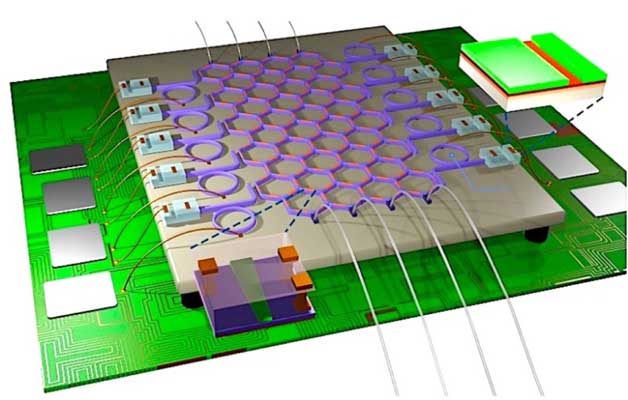
Research into quantum memristive systems and photonic neuromorphic chips promises even greater speed and parallelism, leveraging quantum states or optical signals instead of electrons.
Materials Breakthroughs
New materials like ferroelectric memristors, 2D heterostructures, and organic ionic devices are expanding the design space:
- Ferroelectric devices offer analog, low-voltage switching.
- 2D materials enable atomic-scale thickness and flexibility.
- Organic ionic devices mimic ion-based biological processes more closely.
Future Outlook
The convergence of memresistors and neuromorphic architectures points toward a future where computing systems are:
- Adaptive: Capable of learning and evolving post-deployment.
- Energy-Efficient: Orders of magnitude lower energy per computation.
- Parallel and Scalable: Handling massive sensory data streams in real time.
Key milestones to watch include:
- Standardization of memristor fabrication processes
- Commercial neuromorphic accelerators with memristive computing
- Hybrid AI platforms combining digital, analog, and neuromorphic elements
Conclusion
Memresistors and neuromorphic devices represent a transformative approach to computing, challenging the dominance of conventional architectures in AI and beyond. By fusing memory and computation at the device level, they unlock energy efficiencies and adaptive capabilities that mirror biological intelligence.
As materials, devices, and systems co-evolve, the coming decade promises neuromorphic systems that are not just faster, but fundamentally more intelligent and efficient—extending the reach of electronics into domains once thought exclusive to organic brains.