



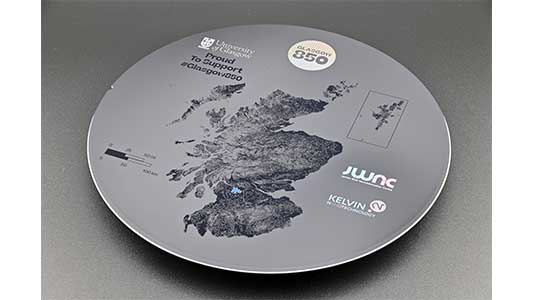
The etching, made on a circular silicon wafer six inches in diameter, includes what the team believe to be the world’s smallest depiction of the River Clyde, which is just 50 microns across – the width of a human hair. The piece was made using the £35m cutting-edge facilities of the University of Glasgow’s James Watt Nanofabrication Centre (JWNC).
The shimmering, iridescent length of the river is one of the highlights of the piece, which contrasts against a highly-patterned representation of the Scottish landscape in ultra-black silicon.
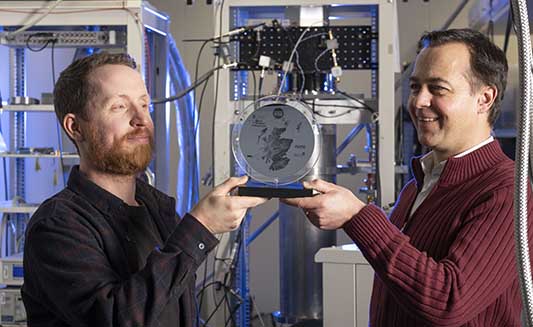
The representation of the River Clyde, and other features like a recreation of the Glasgow 850 logo made up of thousands of tiny versions of the logo, were created using techniques more usually applied by the JWNC to create advanced semiconductor devices for critical technologies. The JWNC produces around 10% of the global supply chain of certain crucial components which enable essential modern technologies like cloud computing and artificial intelligence.
In partnership with the University’s commercial subsidiary Kelvin Nanotechnology (KNT), the JWNC also plays a key role in the development of critical technologies including photonic, semiconductor and quantum components for next-generation devices. It is part of the Scotland’s Critical Technologies Supercluster, established last year, which aims to help secure the country’s economic prosperity in the years to come by supporting advanced manufacturing across the central belt.
Dr Paul Reynolds, a senior research engineer at the James Watt Nanofabrication Centre, led the development of the image and supervised its etching. He said: “We’re proud to be doing our part to celebrate the city of Glasgow’s 850th anniversary with the creation of this wafer, which drew on the combined knowledge of four of the JWNC and KNT’s team of specialists to create. I don’t think there’s anywhere else in the UK which has the mix of technical expertise and manufacturing facilities required to make something this detailed.”
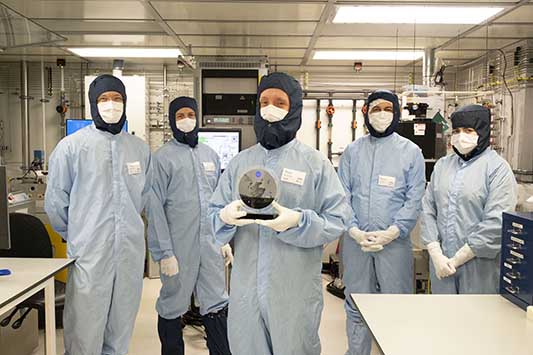
The team began the construction of the piece with a pristine 150mm silicon wafer coated in a special electron-sensitive resist material. Over 24 hours of continuous operation, they etched the contours of the Scottish countryside on the face of the wafer using the JWNC’s £3m electron beam lithography tool. “Think of it like the world’s sharpest pencil,” Dr Reynolds added. “It uses a stream of electrons to draw the incredibly fine patterns required for modern electronics, down to just eight nanometers.”
Once the pattern was written and developed, the team used one of the JWNC’s six plasma etching tools to transfer the design into the silicon itself using two distinct techniques. The first created the image of the countryside using ‘black silicon’, a chaotic texture that produces surface blacker than almost any ink by absorbing light, a technique more commonly used at the JWNC to boost the efficiency of photonic devices.
Then, they created holographic gratings smaller than the wavelength of light itself, creating structures that catch and diffract light. These features produce iridescent highlights on the River Clyde and the Glasgow 850, which appear to change colour depending on viewing angle.
Dr Corrie Farmer and Rachel Love of the JWNC and Dr Kevin Docherty of Kelvin Nanotechnology collaborated with Dr Reynolds on the creation of the wafer, which comes as the University of Glasgow prepares to celebrate its own 575th anniversary next year, as well as mark 20 years since the JWNC began operation in 2006.
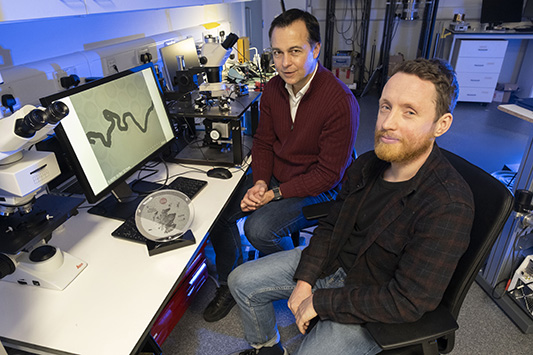
The University is currently developing a proposal to expand its ability to manufacture cutting edge semiconductors, photonics and quantum components with a new facility. The Critical Technologies Nanofabrication Facility (CTNF) aims to take critical technologies from the lab to commercial deployment. The facility will expand the UK’s capability in rapid prototyping and low volume production for SMEs and corporates, reducing their reliance on offshore manufacturing. It will also train highly-skilled staff and contribute to UK economic growth and national security.

Professor Martin Weides, the James Watt Nanofabrication Centre’s director, said: “Advanced manufacturing has been a key part of Glasgow’s history and economic development, with the city making world-leading contributions to industries including textilemaking, shipbuilding, engineering and the life sciences.
“It’s remarkable to think that, when Glasgow was founded, the invention of the printing press was still more than 250 years in the future, but today at the JWNC we’re able to write on silicon at the wavelength of light. The University’s expertise, built over decades and underpinned by more than £150M in collaborative research projects at the JWNC, is helping to enable a wide range of future technologies.
“Our plan for the CTNF will help keep the city at the cutting edge of advanced manufacturing, build the UK’s sovereign capability in critical technologies, and ensure that Scotland can continue to punch well about its weight in tech on the global stage.”
Leader of Glasgow City Council, Councillor Susan Aitken, said: “The University of Glasgow and the James Watt Nanofabrication Centre are not only pushing the boundaries of innovation, but also developing and investing in a highly skilled workforce that will drive Glasgow’s, and indeed Scotland’s, economic growth for decades to come. Their work ensures that the city remains at the forefront of these critical technologies, shaping the future, on a global stage. This accomplishment, in our anniversary year, perfectly sums up our evolution from a traditional manufacturing city to one at the forefront of pioneering precision engineering.”