


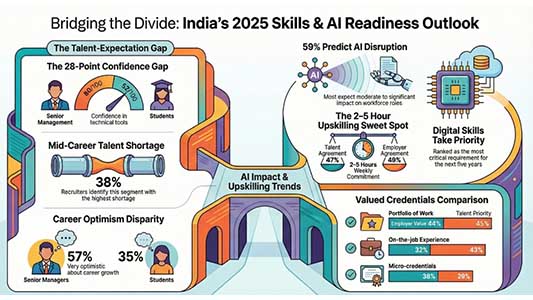
- Mid-career professionals represent the sharpest talent paradox, where demand peaks, but availability remains most constrained
- While 46% of employers actively recruit from this segment, 38% of recruiters identify it as the most constrained talent pool
- 40% of employers expect moderate-to-minimal AI impact on roles, with focus on task redesign and productivity gains rather than job loss
New Delhi – NIIT Ltd., a leading Skills & Talent development corporation, today launched the NIIT India Skills Gap Report 2026, a nationwide study conducted in partnership with YouGov. The survey, based on insights from 3,500 respondents spanning students, working professionals, recruiters, CXOs and academic leaders across key sectors, highlights how digital, data and cybersecurity skills are emerging as foundational capabilities for employability and workforce growth, while industry-recognised certifications and diversity-led skilling are increasingly shaping hiring confidence across organisations.
The study draws responses from 2,800 students and working professionals ranging from early jobbers to senior management and 700 recruiters, CXOs, senior leaders and academic heads, spanning industries such as IT/ITeS, BFSI, manufacturing, healthcare, e-commerce, EdTech, government, FMCG, telecom and auto.

Digital, data and cybersecurity drive future hiring demand
Across the hiring ecosystem, digital and data skills consistently rank among the top three most critical capabilities for the next 3–5 years across all cohorts surveyed i.e. students, employees, recruiters, CXOs and academia. Early-career professionals demonstrate higher confidence than students in cybersecurity basics (64 vs 57), cloud tools (66 vs 56) and data analysis (67 vs 56), while senior management reports the highest overall confidence levels, reflecting experience-backed skill accumulation. Recruiters and CXOs continue to prioritise technical and domain-specific expertise, supported by project management and organisational skills, as organisations accelerate technology-led transformation. Notably, 86% of recruiters and CXOs express confidence in their ability to access skilled talent over the next 3–5 years, with internal reskilling and upskilling capacity (26%) and industry–academia partnerships (24%) cited as the strongest enablers of hiring confidence.
Mid-career talent, reskilling and institutional readiness
The study underscores the importance of mid-career professionals (6–15 years of experience) in India’s talent pipeline. While 47% of employers actively recruit from this segment, 38% of recruiters identify it as the most constrained talent pool, strengthening the case for continuous upskilling across career stages. Encouragingly, 69% of organisations increased their learning and development budgets in the past year, driven by business growth and digital transformation priorities. Additionally, 54% of employers run structured apprenticeship or internship programmes, while scalable EdTech partnerships are gaining traction as a preferred model for delivering industry-aligned, inclusive skilling at scale.
AI accelerates the shift from degree-led to skills-first hiring
As organisations integrate AI into business operations, hiring signals are becoming more precise and outcome-driven. The study reveals that 38% of respondents agree that employers increasingly value certifications and micro-credentials beyond traditional degrees, reflecting a clear move away from degree-only hiring norms. Encouragingly, this shift is accompanied by rising awareness among learners and professionals. 43% of respondents say they are aware of the specific skills employers expect, while an equal proportion actively track in-demand skills within their target industries, indicating stronger alignment between workforce aspirations and evolving industry needs.
Diversity-led skilling moves to the mainstream
The report highlights a clear shift in how organisations approach inclusion through capability building. 44% of organisations now explicitly integrate diversity and inclusion (D&I) goals into all skilling and development programmes, indicating that diversity-led skilling is increasingly embedded into core workforce strategies rather than treated as a standalone initiative. Employers report that early-career and first-generation graduates (53%) and women professionals (48%) are the primary beneficiaries of D&I-linked skilling initiatives, as organisations seek to widen participation in high-growth, technology-driven roles. Academic institutions mirror this intent, placing strong emphasis on supporting students from rural or underserved backgrounds (54%) and first-generation learners (49%) to improve employability outcomes.
Commenting on the findings, Pankaj Jathar, CEO, NIIT Ltd., said: “The NIIT India Skills Gap Report 2026 reinforces that digital, data and cybersecurity skills are now core capabilities across roles and industries. At the same time, organisations are recognising that sustainable talent growth requires inclusive skilling strategies that expand access to these capabilities across diverse talent pools.”
On the importance of inclusive skilling, he further added “Diversity-led skilling is no longer peripheral to workforce planning. By aligning inclusion goals with industry-recognised digital skills, organisations are addressing talent shortages while creating more equitable pathways into emerging roles.”
Key highlights from the report
| Other key findings from the report | |
| Confidence gap in skill readiness | Students rate their overall skill adequacy for the next career step at just 57/100, while senior management professionals score themselves at 82/100 – highlighting a growing assurance that comes with experience and targeted upskilling |
| Optimism divide | Only 35% of students are very optimistic about significant career growth in the next 3-5 years, compared to over 50% of employed professionals across mid and senior levels |
| AI impact expectations | 40% of employers and academic heads anticipate a moderate impact from AI on workforce roles (evolution or displacement), while CXOs are twice as likely as recruiters to predict a transformational shift |
| Upskilling time commitment | Nearly half (47%) of students and employees are willing to dedicate 2-5 hours per week to upskilling, aligning closely with what 49% of employers and academic heads consider a desirable range for staying job-ready |
| Barriers to access | High cost (41%) and lack of awareness about relevant programs emerge as the top challenges to pursuing formal upskilling, cited more frequently than time constraints or motivation issues |
| L&D budget growth | 69% of organisations increased their learning and development spend per employee last year, reflecting a strategic push toward building internal capabilities amid talent shortages |
| Remote-work misalignment | 62% of students prefer hybrid work models, yet only 38% of employers offer fully remote roles across all functions, creating a clear expectation gap for new entrants |
To access the full report: https://www.niit.com/authoring/Documents/Corporate%20Governance/NIIT%20India%20Skills%20Gap%20Report%202026..pdf?utm_source=website&utm_medium=skills_gap&utm_campaign=press_release