

Kyoto, Japan – Nuvoton Technology announced today it will begin mass production in September of battery monitoring ICs (BMICs), KA49703A and KA49713A, optimized for Battery Backup Units (BBUs (*1)) used in AI servers.
As AI servers become critical infrastructure supporting modern society, ensuring continuous operation requires highly reliable power systems capable of running 24/7 throughout the year. By leveraging the company’s proven automotive-grade daisy-chain communication (*2) technology in high-voltage 400V/800V BBU applications, the KA49703A and KA49713A help realize highly reliable and efficient power architecture.
Achievements:
1. Supports daisy-chain communication and connection of up to 55 devices, simplifying large-scale battery system design.
2. Incorporates a transportation and storage mode that extends storage duration and reduces operational costs.
Data centers are mission-critical infrastructure that must operate continuously without interruption. Consequently, their power systems require exceptional reliability and stability. In recent years, the rapid growth of generative AI and cloud services has significantly increased AI server power consumption, driving demand for higher efficiency and reliability in power delivery systems.
At the same time, adoption of 400V and 800V high-voltage power architectures is accelerating to improve power efficiency, while server and power-system densities continue to increase. These trends require battery systems not only to provide safe monitoring under high-voltage conditions but also to ensure long-term reliability and low thermal generation during continuous operation.
Battery systems are no longer simply backup power sources for outages. They now play an increasingly important role in absorbing instantaneous power fluctuations, protecting systems, and ensuring service continuity, making them foundational technologies for modern data centers and communication infrastructure.
Building on its proven automotive daisy-chain communication technology, Nuvoton has developed the KA49703A and KA49713A battery monitoring ICs for high-voltage 400V/800V BBUs used in industrial and infrastructure applications. Mass production is scheduled to begin in September 2026.
The KA49703A and KA49713A can accurately monitor up to 16 battery cells while integrating communication functions for high-voltage systems and safety features such as cell anomaly detection, addressing the demanding requirements of next-generation energy storage systems.
For more product details, please see here:
https://www.nuvoton.com/products/battery-management/battery-monitoring-ics/stackable
Features of New Product:
1. Daisy-Chain Communication Supporting up to 55 Devices

AI-server BBUs and Energy Storage Systems (ESS (*3)) operating at 400V/800V levels require large numbers of lithium-ion battery cells connected in series.
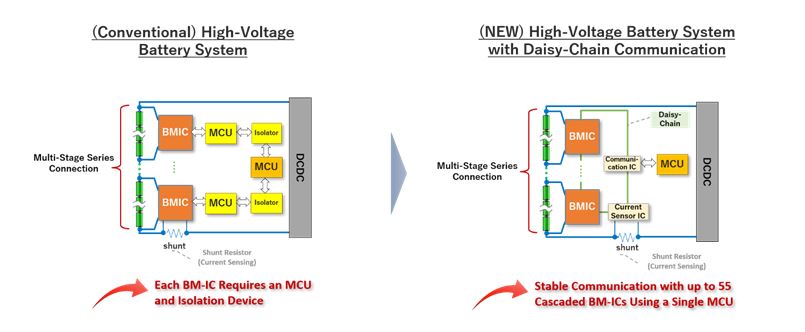
Conventional battery monitoring systems typically require a dedicated MCU and isolation device for each monitoring IC. As cell counts increase, component count and communication wiring also increase, creating challenges in communication reliability and system complexity.
To address these issues, the KA49703A and KA49713A incorporate daisy-chain communication technology. Multiple battery monitoring ICs can be connected in series, enabling systems with up to 55 devices while minimizing wiring requirements and ensuring robust communication even in high-voltage environments.
This architecture reduces the need for additional MCUs and isolation components, simplifying system design, reducing component count, minimizing board space, and improving overall reliability.
The compact QFP-48 package (7 mm × 7 mm) also helps address the stringent space constraints found in AI server BBUs. Combined with high-precision voltage measurement accuracy of ±2.9 mV, the device enhances both monitoring performance and safety in next-generation power systems.
2. Transportation and Storage Mode Reduces Maintenance Costs
AI-server BBUs and large-scale ESS installations contain numerous lithium-ion cells and are often transported over long distances by ship or truck. Minimizing power consumption during transportation and storage is therefore essential.
However, conventional ICs incorporating daisy-chain communication typically exhibit increased shutdown current, leading to battery drain during storage and transport.
To solve this issue, the KA49713A incorporates a dedicated transportation and storage mode that reduces shutdown current to less than 0.1 μA.
This significantly minimizes battery depletion during transportation and storage, extends allowable storage periods, reduces recharge requirements, and contributes to lower operating costs.
These battery monitoring ICs enable customers to address increasing power demands in the AI era and the transition toward higher-voltage power systems. They support improved reliability and operational efficiency in energy storage systems for data centers, industrial equipment, and social infrastructure.
Through continued expansion of its BM-IC product lineup, Nuvoton will further advance battery monitoring technologies and contribute to realizing a sustainable and highly reliable energy society.
Samples are already available, with mass-production shipments scheduled to start in September 2026.
Applications:
・Battery Backup Units (BBUs) for AI servers
・Large-scale Energy Storage Systems (ESS)
Product name:
Industrial Battery Monitoring ICs
・KA49703A
・KA49713A
Specifications:
| Part Number | KA49703A | KA49713A | |
| Communication Interface | Daisy Chain / SPI | ||
| Maximum Number of Cells | 16 cells | ||
| Rated Voltage | 76.8 V | ||
| Voltage Measurement Accuracy | ±2.9 mV | ||
| Shutdown Current | 5.0 μA | ≤ 0.1 μA (Transportation & Storage Mode) | |
| Wake-up Method | Daisy-Chain Signal | Dedicated Wake-up Signal | |
| Package | QFP-48 pin (7 mm × 7 mm) | ||
Example:
Start of mass production:
Sep. 2026
Definitions:
*1 BBU (Battery Backup Unit)
A backup power system equipped with rechargeable batteries, such as lithium-ion batteries, that supplies power during outages or momentary voltage drops.
*2 Daisy-Chain Communication
A communication method in which multiple monitoring ICs are connected in series. It reduces wiring complexity while providing high immunity to electrical noise.
*3 ESS (Energy Storage System)
An energy storage system used for renewable energy integration, peak load management, and power supply-demand balancing.