



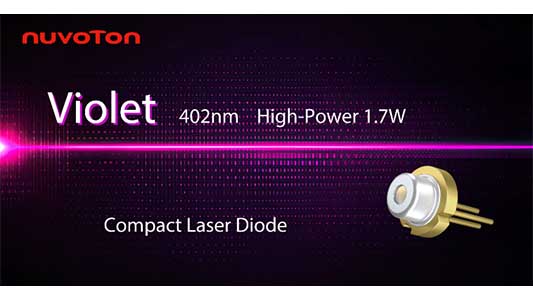
Kyoto, Japan – – Nuvoton Technology announced today the launch of its compact high-power violet laser diode (402nm, 1.7W)[1] which achieves industry-leading(*) optical output power in the industry-standard TO-56 CAN[2] package. This product realizes compact size, high output power and long-life, which were previously considered difficult, through our proprietary chip design and thermal management technologies. As a result, it contributes to space-saving and long-life optical systems for a wide range of optical applications.
(*) As of November 27, 2025, based on our research of semiconductor lasers emitting at a wavelength of 402nm in a TO-56 CAN package.
Achievements:
1. Achieves industry-leading optical output power of 1.7W at 402nm in the industry-standard TO-56 CAN package, contributing to miniaturization of optical systems.
2. Realizes long-life through proprietary chip design and thermal management technologies, reducing running costs of optical systems.
3. Expands the lineup of mercury lamp replacement solutions[3], improving flexibility in product selection according to application.
For more product details, please see here
Semiconductor lasers with a wavelength of 402 nm are being utilized as alternative light sources to the h-line[4] of mercury lamps in applications such as Laser Direct Imaging[5] and resin curing. In recent years, there have been growing expectations for applications in even more areas, including medical devices. In these applications, it is necessary to integrate the light source system into a limited space, which has created a demand for semiconductor lasers that are both compact and high-powered. However, as the optical output power of semiconductor lasers increases, the amount of heat generated also rises, requiring larger heat dissipation structures and resulting in challenges related to package size limitations.
To address this, we have evolved our proprietary chip design and thermal management technologies based on over 40 years of experience in laser design and manufacturing. By designing to reduce optical loss inside the laser chip, heat generation is suppressed. In addition, a new optical facet structure that withstands strong laser light has been adopted, enabling the previously difficult combination of compact size, high output power and long-life. As a result, we have achieved an optical output power of 1.7W in the industry-standard TO-56 CAN package, representing approximately a 40% increase in output power compared to our previous products(*). Furthermore, the reliability indicator MTTF[6] has also been significantly improved. This new product not only contributes to space-saving and long-life in existing applications but is also expected to expand and create new applications that were not possible with conventional light sources.
In addition, this product is newly added to our lineup of mercury lamp replacement solutions using semiconductor lasers, providing customers with new options. This enables flexible product selection according to application, installation environment, and required performance, improving the freedom of system design.
Details of this product will be exhibited at our booth at SPIE Photonics West 2026 in San Francisco, USA, and OPIE’26 in Yokohama, Japan. We look forward to your visit.
(*) Our conventional product: TO-56CAN package KLC433FS01WW
Applications:
- Laser Direct Imaging (LDI)
・ Resin curing
・ Laser welding
・ 3D printing
・ Biomedical
・ Display
・ Alternative light source for mercury lamps, etc.
Product name:
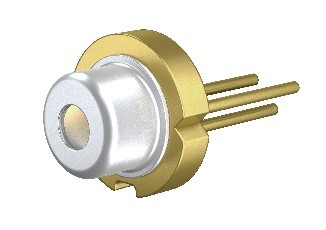
KLC435FS01WW
Specifications:
| Part number | KLC435FS01WW |
| Wavelength | 402nm |
| Optical Output Power | 1.7W |
| Package Type | TO-56 CAN |
Start of mass production: March 2026
Definitions:
[1] Violet laser diode
Our term for semiconductor lasers emits laser light with a peak wavelength approximately in the range of 395nm to 405nm.
[2] TO-56 CAN:
An industry-standard CAN-type package with a diameter of 5.6 mm.
[3] Mercury lamp replacement solutions:
Nuvoton Technology’s lineup of semiconductor lasers designed to replace the emission lines of mercury lamps: i-line (365nm), h-line (405nm), and g-line (436nm). We propose combined use of ultraviolet semiconductor lasers (378nm), violet semiconductor lasers (402nm), and indigo semiconductor lasers (420nm).

[4] The h-line of the mercury lamp:
One of the emission lines of mercury lamps (i-line: 365nm, h-line: 405nm, g-line: 436nm), widely used in industrial applications
[5] Laser Direct Imaging (LDI):
A technology that uses lasers to directly expose circuit patterns onto substrates.
[6] MTTF: Abbreviation for Mean Time To Failure. An indicator showing average failure time.
[SPIE Photonics West]
The world’s largest optics and photonics exhibition, organized by the international society for optics and photonics, SPIE, will be held in San Francisco, USA, from Tuesday, January 20 to Thursday, January 22, 2026. This event will showcase the latest optical technologies, including lasers and optical devices.
[SPIE Photonics West 2026, Nuvoton Booth Web]
Click here for the Nuvoton booth web page at SPIE Photonics West 2026.
[OPIE (OPTICS & PHOTONICS International Exhibition)]
One of the largest specialized exhibitions in Japan for optical technology and photonics will be held at Pacifico Yokohama, from Wednesday, April 22 to Friday, April 24, 2026. Active exchange takes place among the industrial, academic, and research communities.