


As India builds, electrifies, and exports more vehicles than ever, the connectivity and cryptography inside each one must be designed to outlast network shifts across generations of cellular technology and to prepare for the advent of quantum-computing-era threats.
A vehicle leaving an Indian production line this year could still be on the road in 2040. Over that life it will stream its location to government servers, receive over-the-air updates and, if it is a bus or taxi, carry a panic button that must always reach someone. It will allow favorable and safe drivers to avail better insurance tiering, and will predict and mitigate breakdown events, amounting to millions of Crores of Rupees for consumers.
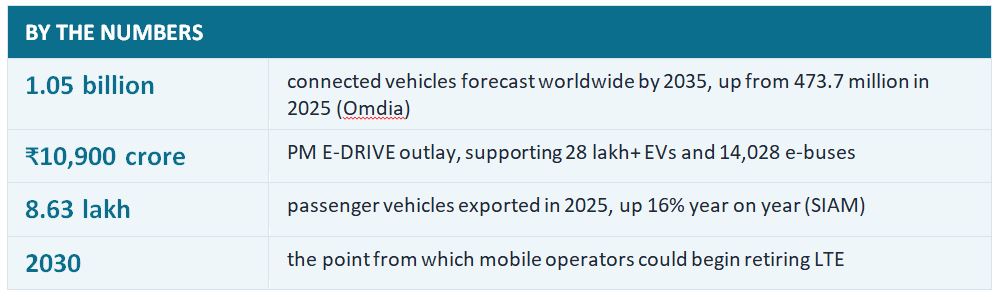
Omdia forecasts more than 1.05 billion connected vehicles worldwide by 2035, up from 473.7 million in 2025 [1]. The question for India’s industry is whether the connectivity and security built in today will still work, and still be trusted, two decades from now.
India is building for itself, and for the world
Under Aatmanirbhar Bharat, the PLI scheme for automobiles requires 50% domestic value addition, and almost all of the ₹2,377.56 crore disbursed by January 2026 went to EV makers [3]. At the premium end, SPMEPCI asks global carmakers to invest at least ₹4,150 crore and reach 50% local value addition by year five. At the affordable end, PM E-DRIVE’s ₹10,900 crore outlay supports more than 28 lakh EVs across two- and three-wheelers and buses [3]. India’s EV sales grew from about 50,000 in 2016 to 2.3 million in 2025 [3].
Exports are rising too, with 8.63 lakh passenger vehicles shipped in 2025, up 16% [5]. Each must connect to foreign networks and meet foreign rules; in Europe, new car and light commercial vehicle types must support Next-Generation eCall from 2026 [1] and follow EU Cybersecurity Resilience Act mandates for security vulnerabilities.
From e-rickshaws to e-buses
AIS-140 requires tracking devices with panic buttons in public service and commercial vehicles, from app-based cabs to school buses and hazardous-goods trucks, streaming data to VAHAN [7]. Some states, including Delhi, extend tracking to e-rickshaws, and electric three-wheelers increasingly embed eSIMs for payments and battery telematics [7].
PM E-DRIVE allocates ₹4,391 crore for 14,028 e-buses, while PM e-Bus Sewa offers operators payment security for up to 12 years per bus [3]. A bus contracted for 12 years needs connectivity and security that last at least as long.
The network sunset problem
India’s fleets have lived through this before. 3G was switched off circle by circle as spectrum was refarmed for 4G, and Vodafone Idea planned to shut 3G completely in FY25 [6]. Devices tied to a single network had to be replaced or retrofitted.
LTE is next. Operators could begin retiring it from around 2030 [1], yet trucks, taxis and e-buses commissioned today will run into the late 2030s. No Indian operator has announced an LTE sunset date, but a vehicle’s design life now exceeds the planning horizon of the networks it relies on.

GSMA SGP.32 eSIMs decouple the vehicle from any single network. They hold multiple operator profiles, which AIS-140 already expects for failover [7], and an eSIM IoT remote manager (eIM) lets fleets switch or add profiles over the air instead of sending technicians.
Prepare for: Harvest now, decrypt later
Adversaries can capture encrypted vehicle data today and decrypt it once quantum computers mature, a risk that matters most for assets in service beyond 2040 [1]. India treats quantum-safe communication as a sovereign capability: C-DOT has unveiled 14 indigenous quantum products, including post-quantum cryptography (PQC) encryptors [4], and India Mobile Congress 2026 paired a Quantum Summit with a Smart Mobility Summit and a cybersecurity-focused Suraksha track [2].
PQC is not yet included in the published GSMA eSIM specifications [1] but is considered an urgent addition for upcoming versions. That is why vehicle makers should start evaluating it now: the silicon chosen in the next few years sets the security posture for the next two decades.
Built for the long road
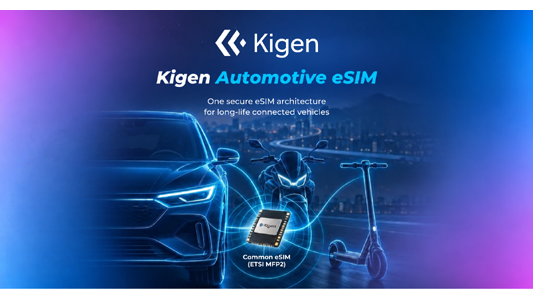
Kigen’s Automotive eSIM is the industry’s first eSA-certified eSIM supporting SGP.32 v1.3 [1]. Built on Infineon TEGRION secure silicon, it is qualified to AEC-Q100 with 17-year data retention, CC EAL6+ and ISO/SAE 21434, and is managed through a GSMA SAS-certified eIM [7]. These capabilities are certified as a family – meaning, it’s one platform that works across Automotive, IoT and consumer, all tested with more than 60 modules spanning 5G, 4G and NB-IoT, alongside India’s NavIC positioning. Unveiled in time for the India Mobile Congress, the conversation around eSIM in India for automotive cybersecurity has expanded.
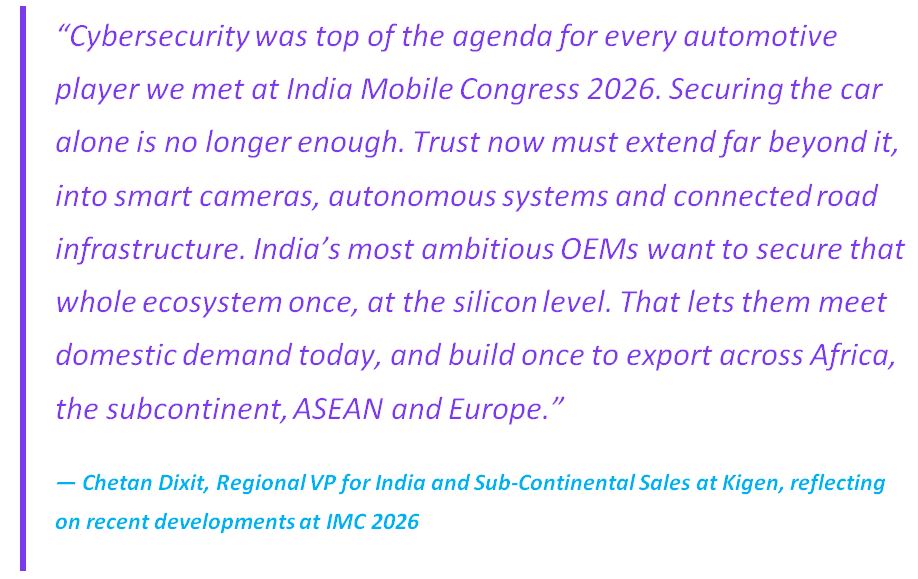
Kigen’s eSIM Software Development Kit, test eSIMs and PQC-capable hardware let manufacturers evaluate hybrid classical and quantum-safe key establishment today, on one platform spanning passenger cars, two-wheelers, commercial vehicles and industrial fleets [7].
Connected fleets can deliver 5–15% lower operating costs and 10–20% higher asset utilisation [7], but only if they stay connected and trusted. The vehicles India builds this year will outlive today’s networks and today’s encryption. The time to design for that is now.
About the author

Bee Hayes-Thakore is VP of Marketing at Kigen. An engineer-turned-technologist from Gujarat, Bee works with global frontier tech companies to bring security to the core of their business value generation with Kigen. Kigen is a hyper-growth technology provider for secure eSIM and remote SIM provisioning across automotive, IoT, and consumer manufacturers. With a permanent base in Noida, New Delhi, since 2017, Kigen has further invested in supporting India’s eSIM ecosystem through expert teams in Mumbai, Bangalore, and Pune. As one of the fastest-growing scale-ups with global impact, over 30% of Kigen’s employees are based in India. Find out more at https://kigen.com/kigen-india/
References
[1] Kigen blog, “Automotive eSIM and 1 billion connected vehicles”. https://kigen.com/resources/blog/automotive-esim-1-billion-connected-vehicles/
[2] Business Standard, “India Mobile Congress 2026 begins Oct 7 with 6G, AI, cybersecurity in focus”. https://www.business-standard.com/technology/tech-news/india-mobile-congress-2026-begins-oct-7-with-6g-ai-cybersecurity-in-focus-126100600736_1.html
[3] PIB, “Roads Reimagined: The Rise of India’s Electric Vehicles Ecosystem”, 5 August 2026. https://www.pib.gov.in/PressReleasePage.aspx?PRID=2294688®=48&lang=1
[4] PIB, “C-DOT Unveils 14 Indigenous Quantum Products to Strengthen Security of India’s Communication Networks”. https://www.pib.gov.in/PressReleaseDetail.aspx?PRID=2305167®=48&lang=1
[5] Business Today, “India’s car exports jump 16% to 8.63 lakh vehicles in 2025”, 13 January 2026. https://www.businesstoday.in/india/story/indias-car-exports-jump-16-to-863-lakh-vehicles-in-2025-510770-2026-01-13

[6] TelecomTalk, “Vodafone Idea to Shut Down 3G Completely in FY25”, 31 January 2024. https://telecomtalk.info/vodafone-idea-to-shut-down-3g-completely-in-fy25/915663/
[7] Kigen, “IoT eSIMs for Indian Connected Vehicle Fleets” solution brief, 2026.