



The premium display industry is approaching an important inflection point. Screen size and resolution are no longer enough to differentiate high-end televisions and monitors. Consumers increasingly expect richer colors, deeper contrast, faster response times, higher refresh rates, and a more immersive viewing experience.
That is putting the spotlight on Quantum-Dot OLED (QD-OLED).
By combining OLED’s self-emissive technology with quantum-dot materials, QD-OLED is designed to deliver deep blacks, high contrast, vibrant colors, and fast response performance. For manufacturers, those capabilities offer something increasingly valuable: a way to make premium products visibly different in a market where specifications are becoming increasingly standardized.
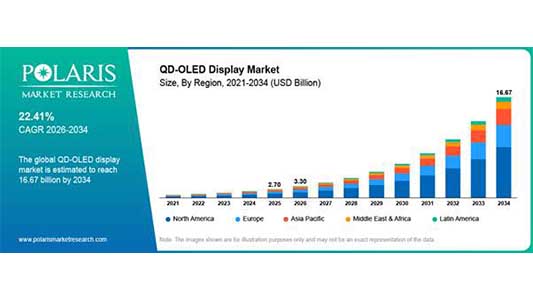
The opportunity is substantial. According to Polaris Market Research, the global QD-OLED Display Market was valued at USD 2.70 billion in 2025 and is estimated to reach USD 3.30 billion in 2026. By 2034, the market is projected to reach USD 16.67 billion, expanding at a 22.41% CAGR from 2026 to 2034.
The numbers point to a larger strategic shift: QD-OLED is moving from a premium display innovation toward a major competitive platform for consumer electronics companies.
Why QD-OLED Is Becoming a Premiumization Strategy
For electronics brands, premiumization is becoming harder.
Consumers can already access 4K resolution, HDR, high refresh rates, smart-TV capabilities, and increasingly sophisticated image-processing technologies across a broad range of products. Simply adding another specification may no longer justify a substantial price premium.
Display architecture can change that equation.
QD-OLED combines the pixel-level control of OLED with quantum-dot technology to enhance color performance. Because individual OLED pixels can be controlled independently, the technology can produce deep blacks and strong contrast while supporting vivid and highly detailed imagery.
That creates a compelling proposition for premium televisions, gaming monitors, professional displays, and enthusiast computing.
For manufacturers, the opportunity is therefore less about selling a better panel and more about selling a noticeably better experience.
Gaming Could Become One of QD-OLED’s Biggest Growth Engines
Gaming is changing the economics of premium displays.
Players increasingly demand high refresh rates, extremely fast response times, HDR performance, accurate colors, and strong contrast. These requirements align closely with the capabilities that make QD-OLED attractive.
The market data reinforces the opportunity. Polaris Market Research projects the monitor segment to grow at an 11.60% CAGR during the forecast period.
Gaming also creates an unusually receptive customer base for premium hardware. Enthusiast gamers are often willing to pay for measurable improvements in responsiveness and image quality, making gaming monitors an important pathway for QD-OLED adoption.
This gives manufacturers an opportunity to diversify beyond traditional television markets and build higher-value product portfolios around gaming, content creation, and professional visualization.
The Market Structure Reveals Where the Opportunity Lies
The distribution of demand provides another important signal.
The below-32-inch panel segment accounted for 56.70% of the QD-OLED market in 2025. This reflects strong demand for smaller premium displays, particularly gaming and professional monitors.
At the same time, the 32-to-55-inch panel-size segment is expected to register the fastest growth during the forecast period as QD-OLED expands across televisions and other display applications.
This creates an interesting strategic balance.
Televisions can provide significant volume and mainstream visibility, while gaming and professional monitors can support premium pricing and faster adoption among technology-focused customers.
For manufacturers, the winning strategy may therefore be to use different product categories for different commercial objectives rather than relying on a single QD-OLED market.
For more information, visit @ https://www.
Consumer Electronics Remains the Core Revenue Opportunity
Consumer electronics represented 63.40% of the global QD-OLED market in 2025, making it the largest end-user segment.
Televisions remain a major demand center as consumers seek increasingly sophisticated 4K and 8K viewing experiences. However, gaming is expected to be the fastest-growing end-user segment, reinforcing the importance of monitors and other performance-oriented displays.

This distinction is strategically significant.
Televisions can help establish QD-OLED as a mainstream premium technology, while gaming can accelerate adoption among consumers who actively compare display specifications and are more likely to upgrade for performance gains.
The combination creates a powerful growth model: scale through consumer electronics and differentiation through high-performance applications.
Asia Pacific Leads the Industry, While North America Gains Momentum
The regional landscape highlights the connection between manufacturing capability and premium consumer demand.
Asia Pacific accounted for 48.30% of the QD-OLED Display Market in 2025, making it the largest regional market. The region benefits from its extensive electronics manufacturing infrastructure and the presence of major display and consumer-electronics companies.
South Korea remains particularly important to advanced OLED development, while China and Japan contribute significant manufacturing, component, and electronics capabilities.
North America, meanwhile, is expected to be the fastest-growing regional market. Strong demand for premium televisions, gaming monitors, professional displays, and advanced consumer electronics is supporting expansion.
For global businesses, this creates a complementary opportunity: Asia Pacific remains central to the supply chain and manufacturing ecosystem, while North America offers substantial premium-demand potential.
Competitive Landscape: Technology Alone Will Not Win
The QD-OLED competition is extending beyond panel performance.
Major companies across the display ecosystem—including Samsung Display, Sony, LG Electronics, Dell Technologies, ASUS, Acer, HP, Lenovo, MSI, Philips, Gigabyte Technology, and TCL Technology—are competing through product innovation, manufacturing capabilities, display integration, and brand positioning.
The critical issue is scale.
QD-OLED still faces challenges related to production costs, manufacturing capacity, and the economics of expanding beyond premium products. Companies that can improve production efficiency and increase availability could gain an important advantage.
At the same time, brands with strong premium positioning can use QD-OLED to strengthen flagship product lines and defend higher average selling prices.
The competitive advantage will therefore come from combining technology, manufacturing scale, product design, and customer experience.
Future Outlook: Can QD-OLED Move Beyond the Premium Niche?
The projected 22.41% CAGR through 2034 suggests that QD-OLED has considerable room to expand.
The next phase will depend on how successfully manufacturers address production costs and expand the technology into additional applications. Professional visualization, content creation, automotive displays, and other specialized markets could provide new opportunities as display requirements become more demanding.
The key question is not whether QD-OLED can deliver premium performance. It already can.
The bigger question is whether manufacturers can scale that performance economically enough to reach a much broader customer base.
If they succeed, QD-OLED could move from being a premium differentiator to a broader display platform.
Read More @ https://www.