


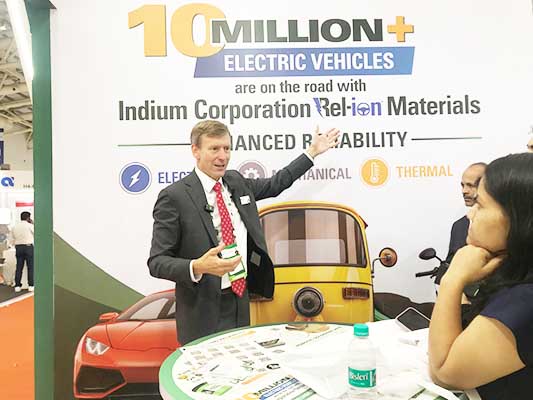
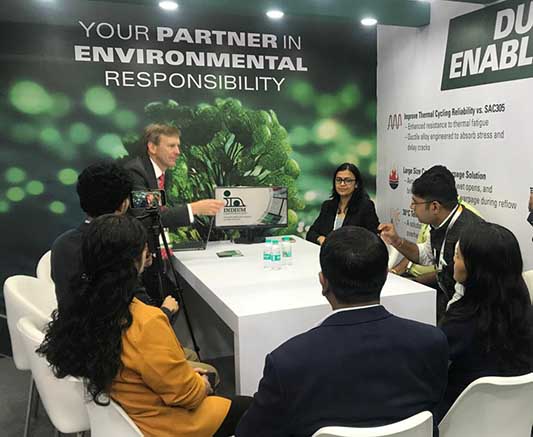
With this witty challenge, Ross Berntson, President and CEO of Indium Corporation, opened his engaging presentation during electronica India 2025 Expo — immediately blending charm, chemistry, and corporate vision. A former chemistry teacher turned industry leader, Berntson’s storytelling style bridged science with strategy, taking his audience on a journey through Indium Corporation’s innovation, its deep ties with India, and the transformative power of material science.
Berntson’s visit wasn’t just another corporate stop on a global tour — it was a celebration of Indium Corporation’s deepening relationship with India’s rapidly growing electronics manufacturing ecosystem. It was also a declaration of faith in India’s potential to lead the next wave of innovation in advanced materials and semiconductor packaging.
A Chemist at Heart, a Leader by Vision
Berntson’s career is as unique as Indium’s namesake — element number 49 on the periodic table. “I joined Indium in 1996,” he told the audience with a grin. “I’m an old chemistry teacher.” The educator in him still shines through — whether he’s explaining the nuances of solder alloys or the philosophy behind Indium’s innovation culture.
For Berntson, material science isn’t just a technical field; it’s the invisible force behind human progress. “If you look through history, almost every great age had a new advance in materials,” he said. “We believe material science changes the world.”
That belief forms the bedrock of Indium Corporation’s identity — and its role in shaping industries from electronics to aerospace, and from renewable energy to medical technology.
The Chemistry of Innovation: Indium’s Core Philosophy
Indium Corporation’s work revolves around a simple yet profound principle: everything in electronics manufacturing is, at its heart, a chemical reaction.

“Most people look at a PCB assembly line as a bunch of machines — robots, dials, and buttons,” Berntson explained. “We don’t look at it that way. We see it as a chemical reaction. You put reactants in, and you put it all through the oven to make the solder joints — to complete the reaction.”
That scientific perspective, rooted in chemistry, has given Indium an edge in developing solutions for complex challenges in electronics manufacturing. From semiconductor packaging to advanced PCB assembly, Indium’s materials have been critical enablers of modern technology.
At the core of this innovation is Indium’s family of advanced solder materials — the invisible connections that hold together the electronic world.
Durafuse LT: The Product of Persistence and Partnership
One of Berntson’s most powerful stories centered on Durafuse LT, a breakthrough solder technology. “That product was developed because a customer had a problem,” he said. “They couldn’t make a reliable mobile phone without a new material.”
The journey to success wasn’t immediate. “Our first product crashed and burned,” Berntson recalled candidly. “The next one failed too. But through collaboration — our engineers on their factory floor, their engineers in our labs — we solved it together.”
The result was a game-changing innovation. Durafuse LT not only improved reliability and enabled new assemblies but also delivered a major sustainability win by lowering reflow oven temperatures by around 40°C.
“Imagine that across 2,000 SMT lines in India,” Berntson said. “Now double that number in two years — all-consuming less energy. That’s how material science can make a real difference.”
Empowering Engineers: From One Engineer to Another
For Berntson, innovation isn’t confined to labs or boardrooms — it happens where engineers meet challenges head-on. That’s why Indium invests heavily in technical collaboration and training.
“Creating world-class materials isn’t enough,” he said. “If we don’t help our customers use them, it’s like giving someone a Formula One car without teaching them how to drive.”
To bridge that gap, Indium’s engineers work directly with customers on factory floors, ensuring that advanced materials are used effectively. The company also collaborates with partners like Heller and Zestron, as well as top Indian universities including the IITs and IISc, to train the next generation of engineers in the science of soldering and material performance.
“We bring our engineering talent to our customers,” he said proudly. “That’s what we mean when we say, from one engineer to another.”
Sustainability through Science
Sustainability, for Indium, isn’t a marketing slogan — it’s built into the company’s materials and manufacturing. Indium is a global leader in recycling specialty materials such as indium, gallium, and germanium — critical elements in modern electronics.
“We operate a refinery in Korea,” Berntson explained. “We’re working with universities around the world on how to extract even more of these critical materials — keeping them out of landfills and part of a circular economy.”
That sustainability focus aligns perfectly with India’s growing emphasis on renewable energy and green manufacturing. As India becomes a hub for solar module and semiconductor manufacturing, energy-efficient materials like Durafuse LT could play a vital role in reducing environmental impact.
Indium in India: A Growing Footprint
Indium Corporation’s relationship with India is decades old — but its local presence has never been stronger. The company’s manufacturing facility in Guindy, Chennai, produces solder paste — a critical material for SMT assembly.
“It’s like food — perishable and local,” Berntson said, highlighting why Indium chose to manufacture in India. “You don’t need a big footprint to start. It’s what you do with it that matters.”
The company’s Indian operations are growing rapidly — over 50% year-on-year, according to Berntson — and expansion plans are already underway. “We’ll need another factory soon,” he said. “I even got to break the coconut when we opened the first one — I think I got a B-minus on that,” he joked.
With that lighthearted humility came a serious message: Indium Corporation is committed to growing with India — not just as a supplier, but as a partner in innovation.
Hiring for the Future
One of the most passionate moments of Berntson’s presentation was his appeal to young engineers. “We’re hiring,” he said with visible excitement. “If you know young engineers, send them our way. The talent in India will help us across the globe.”
When asked what skills aspiring material engineers should focus on, Berntson’s answer reflected his teacher’s heart. “Be curious,” he said. “Metallurgy is wonderful, but curiosity is the number one skill. The next breakthrough won’t come from a catalogue — it’ll come from someone thinking differently.”
He encouraged Indian engineers to blend material science with software and simulation — areas where India already excels. “Imagine combining materials science with India’s software talent to design purpose-specific alloys,” he said. “That’s how we’ll build the next generation of materials.”
Innovation through Collaboration
Collaboration is a recurring theme in Indium’s philosophy. The company doesn’t just sell materials — it co-creates solutions. By working closely with OEMs, universities, and research partners, Indium accelerates innovation that benefits entire industries.
Berntson praised India’s academic and industrial ecosystem. “There’s an incredible network here,” he said. “We’re sponsoring master’s students, collaborating with universities, and partnering with companies like Heller and Zestron. Our goal is to scale the market by scaling the talent.”
He envisions a future where Indium Corporation will establish R&D capabilities in India, enabling innovation to emerge directly from the local ecosystem.
A Vision Aligned with India’s Growth
Berntson’s deep respect for India’s manufacturing ambitions was evident throughout his talk. He celebrated India’s “multi-technology ramp-up” — the simultaneous rise of semiconductor packaging, advanced PCB assembly, and component manufacturing — something no other country has achieved this way.
“In India, everything is happening at once,” he said. “That’s never happened anywhere else. It creates opportunities for new ways of thinking — new ways of using materials, producing products, and solving industry problems.”
As he attempted to pronounce “Atmanirbhar Bharat” — India’s vision of self-reliance — Berntson’s good-humored struggle drew laughter and applause. “I’ve got to work on that,” he admitted. But his message was clear: Indium Corporation’s growth in India is deeply aligned with that national vision.
The Human Element
Perhaps the most touching moment of Berntson’s presentation came when he shared a personal story. His father once received an implantable medical device that contained gold preforms manufactured by Indium Corporation.
“My father had our material in him,” Berntson said, his voice softening. “That’s when you realize the work we do truly impacts lives.”
It was a reminder that behind the alloys, the data sheets, and the factory floors lies something profoundly human — the drive to improve lives through the science of connection.
A Future Forged in Chemistry and Collaboration
As Ross Berntson concluded his talk, it was clear that his enthusiasm for chemistry — and for India — is as infectious as ever. Indium Corporation isn’t just expanding operations; it’s building relationships, fostering talent, and shaping the material foundation of tomorrow’s technologies.
In his own words, “We’re just getting started in India — and India is just getting started too.”
From solder joints to human connections, Berntson’s vision reflects the perfect chemical equation: curiosity + collaboration + commitment = innovation.
And perhaps, by the end of his talk, even those who once said gold began to see the true brilliance of indium.