


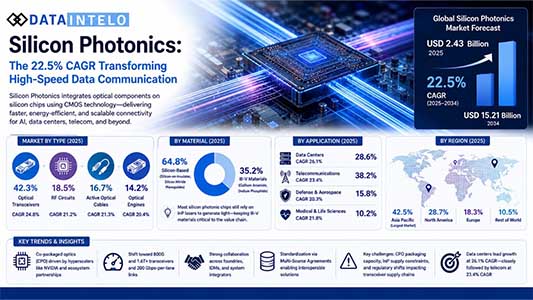
Copper has run out of road. Each and every AI training cluster, and every hyperscale data center, is now facing the same problem electrical interconnects can just not transfer data fast, far, and efficiently enough from the standpoint of energy use to match the demands of clusters of GPUs that have to communicate with each other at terabits per second speed. The solution to this problem is Silicon Photonics, which is essentially the technique of adding optical components onto conventional silicon wafers through CMOS technology utilized in creating conventional chips. Based on the report of DataIntelo, the value of the global market for silicon photonic technology will increase from $2.43 billion in 2025 to $15.21 billion by 2034 at a CAGR of 22.5%.
Inside the Forecast: Segment and Material Shifts
The report’s breakdown by type is where the forecast turns into something planning teams can actually use. Optical transceivers are the dominant category, holding 42.3% share in 2025 and expanding at 24.8% CAGR, faster than the market overall, as bandwidth scaling in data centers pulls demand ahead of telecom’s historical pace. RF circuits, used heavily in defense and radio-over-fiber applications, hold 18.5% share and are growing at 21.2%. Active optical cables and optical engines round out the picture at 16.7% and 14.2% respectively, both expanding above 20% annually as data centers standardize on pluggable and disaggregated optical formats.
On materials, silicon-based platforms chiefly silicon-on-insulator and silicon nitride waveguides hold 64.8% of the market on the strength of CMOS compatibility and foundry scale, while gallium arsenide and indium phosphide account for the remaining 35.2%, doing the work silicon still cannot: generating light directly. That split matters more than it looks. Nearly every silicon photonic transceiver on the market today still needs an indium phosphide laser bonded onto the silicon chip, which means the industry’s dependence on III-V materials is not shrinking nearly as fast as its dependence on silicon fabrication is growing — a tension that shows up directly in the supply chain risks discussed further below.
Recent Developments Setting the Pace
Supplier and hyperscaler activity has moved quickly in 2026. Nvidia used this year’s roadmap disclosures to confirm its shift away from pluggable transceivers toward co-packaged optics, starting with Quantum-X InfiniBand switches delivering 115 Tb/s across 144 ports at 800 Gb/s each, built on TSMC’s COUPE optical engine platform. Nvidia’s own figures claim a 3.5x improvement in power efficiency and a 64x improvement in signal integrity versus pluggable modules — numbers that are pulling the rest of the ecosystem toward co-packaged designs faster than most planners expected even a year ago.
The launch of the SCALE co-packaged optics technology platform by GlobalFoundries in May 2026 marked the debut of a technology designed to fit the specifications of the Optical Compute Interconnect Multi-Source Agreement for scaling-up architecture for AI. It was soon followed by an agreement between GlobalFoundries and Siluxtek for production of 200 Gbps-per-lane silicon photonic receiver chips. The forecast by the Yole Group from its 2025 silicon photonics report indicates that 200 Gbps-per-channel links will become widely used in 2026 and 2027, which would allow 800G and 1.6T transceivers, and mass co-packaging of opticals will happen in 2028 to 2030 rather than before.
What’s Actually Driving the Industry
Data centers provide the clearest evidence of this growth driver, and there are figures to prove it: an estimated 68% of data centers deployed in 2025-2026 use silicon photonics interconnects, compared to just 42% of those launched in 2021-2022. The study shows data center applications expanding with a 26.1% CAGR until 2034, the fastest among all application segments, even surpassing communications infrastructure, due to hyperscalers like AWS, Microsoft Azure, and Google Cloud deploying optical interconnects in rack level and inter-rack architectures in order to stay on top of generative AI traffic. LightCounting expects laser and photonic integrated circuit sales for optical transceivers to expand from $2.4 billion in 2023 to $5.9 billion in 2029, which is largely due to AI data center investments.
Telecommunications continues to account for the biggest share of the market at 38.2%, but is expected to post an impressive annual growth of 23.4% thanks to the continued densification of 5G networks and research into 6G that relies on silicon photonic RF circuits for radio-over-fiber fronthaul and backhaul. On the other hand, the Defense and Aerospace sector accounts for 15.8% of the overall market, but only grows at a 20.3% CAGR pace. Medical and life sciences, though only 10.2% of the market today, is compounding at 21.8% as optical coherence tomography and point-of-care diagnostics adopt silicon photonic sensors for their combination of compactness and low power draw.

Regional Outlook and Regulatory Developments
Asia Pacific holds the largest share of the silicon photonic market at 42.5%, anchored by TSMC, Samsung Foundry, and GlobalFoundries’ advanced photonics fabrication capacity, along with aggressive 5G and data center buildouts across China, Japan, South Korea, and Singapore. North America follows at 28.7%, carried by Intel, IBM, and Infinera’s technology leadership and the concentration of hyperscale data center capex in the region. Europe holds 18.3%, supported by Horizon Europe research funding and an EU regulatory environment that increasingly rewards the lower power draw of photonic interconnects over legacy optical technology.
The regulatory story that deserves more attention from procurement teams than it is currently getting is the U.S.-China optical transceiver standoff that escalated sharply through mid-2026. The FCC is reportedly drafting rules that would deny equipment authorization to new models of Chinese-made optical transceivers, aiming to publish the measure before the end of 2026, on national security grounds tied to concerns about the hardware becoming a vector for data theft or service disruption. That matters because Chinese manufacturers — Zhongji Innolight and Eoptolink among them — currently produce a large share of the 800G and 1.6T optical modules that U.S. hyperscalers depend on, and domestic U.S. capacity cannot yet fully substitute for that supply. Some Chinese producers have already begun shifting assembly to Thailand to manage tariff and origin exposure ahead of the rule.
The dependency runs in both directions. China has controlled exports of indium phosphide since 2025, and Western transceiver makers still need InP-based lasers to generate the light that silicon photonic chips route and modulate — meaning a full U.S.-China photonics decoupling would cut against American suppliers just as directly as it would against Chinese ones. Industry commentary has flagged this as a case where both governments risk supply chain leverage they may not fully control, given how tightly the laser-source and packaging steps of the value chain remain intertwined.
Technology Trends and Case Studies
Co-packaged optics is the technology transition defining this decade of silicon photonics, and it is arriving through platform partnerships rather than single-company breakthroughs. Nvidia’s Quantum-X and Spectrum-X roadmap leans on TSMC’s COUPE optical engine process; GlobalFoundries built SCALE specifically to meet the new OCI Multi-Source Agreement spec rather than a proprietary standard, signaling that the industry wants interoperable optical interconnects the way it settled on interoperable electrical ones decades ago. Corning, GlobalFoundries, and EXFO jointly demonstrated a full CPO ecosystem in 2026, covering everything from fiber attach to packaging validation, which is the kind of vertical-plus-horizontal collaboration that historically signals a technology is close to production scale rather than still experimental.
On the commercial transceiver side, Cisco’s ownership of Luxtera continues to demonstrate the value of vertical integration — controlling transceiver design, active optical cable manufacturing, and network equipment integration under one roof gives Cisco pricing and qualification advantages that pure-play component vendors cannot easily match. Intel’s dual role as both a silicon photonics foundry and a vertically integrated product company remains one of the more closely watched competitive positions in the market, particularly as its Foundry Services unit courts data center customers who want an alternative to TSMC and Samsung for photonic-specific process nodes.
Challenges and What This Means for Decision-Makers
The binding constraint on silicon photonics right now is not customer demand — it is qualification cycles and packaging capacity. Co-packaged optics requires 2.5D interposers and hybrid bonding capabilities that are still scaling, and Yole’s own analysis pushes large-volume CPO deployment out to 2028-2030 rather than sooner, which should temper any procurement roadmap built around near-term CPO availability. Indium phosphide supply, concentrated and increasingly politicized, is a second real constraint: InP wafer prices have stabilized in the $4,000-$6,000 range as alternative supply remains limited, and any tightening of Chinese export licensing would move that number quickly.
For engineering leaders, the practical decision is less “silicon photonics or not” and more which packaging architecture pluggable, linear-drive pluggable, or co-packaged to design around for a given product generation, since each carries different power, cost, and qualification timelines. For procurement leaders, the FCC’s pending transceiver rule and China’s InP licensing posture argue for building supplier diversity now, well before a 2026 rule change forces a scramble; component sourcing decisions made this year will determine who can actually ship 800G and 1.6T systems on schedule next year. For strategists watching where AI infrastructure capital is actually landing, silicon photonics has become one of the more reliable proxies available: the segments growing fastest inside this market data centers at 26.1% CAGR, ahead of telecom’s already-strong 23.4% are simply following the AI buildout, and the regional and regulatory friction building around that buildout is now as important a signal as the headline CAGR itself.
Reference: https://dataintelo.com/report/global-silicon-photonic-market