


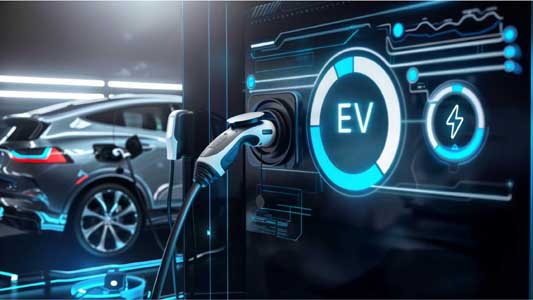
The global electric vehicle (EV) revolution is entering a new era. Where the first wave of electrification relies on replacing internal combustion engines with battery-powered alternatives, the next phase is being led by intelligence. Artificial Intelligence (AI), machine learning, cloud computing, and data analytics are transforming EVs from simple electric machines into intelligent, connected, and energy-efficient mobility platforms.
AI enables EVs to empower battery performance, extend driving range, reduce charging time, predict maintenance needs, and seamlessly integrate with renewable energy and smart grids.
Industry leaders including Tesla, BYD, Mercedes-Benz, BMW, Volvo, ABB, Siemens, NVIDIA, CATL, and Schneider Electric are investing billions of dollars in AI-powered mobility solutions. Their innovations are setting new benchmarks for the automotive industry while reshaping how governments, businesses, and consumers think about transportation.
AI: The Brain Behind Modern Electric Vehicles
Unlike conventional vehicles, electric vehicles continuously generate enormous amounts of data. Every journey produces information related to battery temperature, charging patterns, motor efficiency, energy consumption, driving behaviour, weather conditions, road gradients, traffic flow, and vehicle diagnostics.
Artificial Intelligence processes this data in real time, enabling vehicles to make intelligent decisions that improve efficiency, safety, and performance.
Rather than following fixed operating parameters, AI-powered EVs continuously learn from driver habits and environmental conditions, adjusting energy usage dynamically. This significantly improves battery utilization while reducing unnecessary energy loss.
Tesla: The Benchmark for Intelligent Energy Management
When discussing AI in electric mobility, Tesla remains the global benchmark. Beyond being an automobile manufacturer, Tesla has positioned itself as a software and AI company.
Its Battery Management System (BMS) continuously monitors thousands of battery cells, analysing voltage, current, temperature, and charging behaviour. Machine learning algorithms optimize charging cycles to reduce battery degradation while extending overall battery life.
Tesla’s navigation system uses AI to calculate the most energy-efficient route by considering traffic congestion, elevation changes, weather conditions, driving speed, and the availability of Supercharger stations.
The company’s regenerative braking system is equally intelligent. AI predicts deceleration patterns and determines how much braking energy should be recovered and stored back into the battery, improving driving range without compromising comfort.
Tesla also integrates vehicles with home energy storage systems such as Powerwall and solar panels, creating an ecosystem where vehicles can operate as intelligent energy assets rather than merely transportation devices.
BYD: Intelligence Meets Battery Innovation
China’s BYD has become one of the world’s largest EV manufacturers through its vertically integrated approach.
Its Blade Battery technology combines advanced battery chemistry with AI-powered monitoring systems that continuously evaluate battery health, temperature, charging efficiency, and safety parameters.
The company uses AI to optimize thermal management—one of the most critical factors affecting battery longevity. Intelligent cooling systems automatically regulate battery temperatures during charging, high-speed driving, and extreme weather conditions.
BYD is also investing heavily in smart manufacturing, where AI monitors production quality, predicts equipment failures, and improves manufacturing efficiency across battery plants.
Mercedes-Benz: Building the Intelligent Luxury EV
Mercedes-Benz has integrated AI across its EQ electric vehicle lineup through the MBUX (Mercedes-Benz User Experience) platform.
The system learns driver preferences, predicts destinations based on routines, recommends optimal charging stops, and manages cabin climate while minimizing battery consumption.
Its Intelligent Navigation system continuously recalculates routes using traffic conditions, charging infrastructure availability, battery status, and driving behaviour.
Mercedes is also leveraging digital twins—virtual replicas of physical batteries—to monitor battery health throughout the vehicle lifecycle. This enables predictive maintenance while improving warranty management and recycling strategies.
BMW’s Predictive Energy Management
BMW’s electric vehicles showcase how AI can personalize energy management.
Instead of treating every driver identically, BMW’s software studies individual driving styles over time.
Aggressive acceleration, frequent braking, highway driving, and urban commuting all affect battery performance differently. AI continuously adapts energy distribution based on these patterns.
BMW’s navigation system predicts energy consumption for every route while recommending charging strategies that reduce travel time and maximize battery efficiency.
The result is a vehicle that becomes increasingly efficient as it learns from its owner.
Volvo: AI for Commercial Fleet Optimization
Commercial electric fleets face very different challenges compared to passenger vehicles.
Fleet operators require maximum uptime, predictable maintenance, and optimized charging schedules.
Volvo Trucks has implemented AI-driven predictive maintenance systems that monitor motors, batteries, braking systems, and drivetrain components in real time.
Instead of waiting for components to fail, AI predicts maintenance requirements weeks in advance, minimizing downtime and reducing operational costs.
Fleet managers receive real-time recommendations on charging schedules, driver behaviour, and route optimization, improving overall fleet productivity.
CATL: Making Batteries Smarter
As the world’s largest EV battery manufacturer, CATL is redefining battery intelligence.
Its cloud-connected battery management platforms analyse millions of battery cells operating across different geographies and climates.
Machine learning models identify patterns associated with degradation, overheating, charging inefficiencies, and performance loss.
By continuously updating battery software, CATL enables manufacturers to improve battery life without changing physical hardware.
This software-defined approach represents one of the biggest shifts in battery technology.
ABB and the Future of Smart Charging
Charging infrastructure is becoming as intelligent as vehicles themselves.
ABB E-mobility has developed AI-powered charging systems capable of balancing electricity demand across multiple charging stations.
Rather than drawing maximum power simultaneously, AI distributes energy dynamically based on vehicle priority, battery status, electricity tariffs, and local grid conditions.
This reduces peak electricity demand while improving charger utilization.
Such systems are particularly valuable for commercial fleets, shopping centres, airports, and urban charging hubs.
Schneider Electric: Connecting EVs with Smart Grids
The future of mobility extends beyond vehicles to the broader energy ecosystem.
Schneider Electric is integrating EV charging infrastructure with smart buildings, renewable energy systems, and digital electricity grids.
AI forecasts electricity demand, predicts renewable energy generation, and determines the most efficient charging schedules.
For example, charging can automatically shift to periods when solar or wind energy generation is highest or when electricity prices are lowest.
This not only reduces costs but also minimizes pressure on national electricity grids.
NVIDIA: The AI Computing Powerhouse
While automakers build intelligent vehicles, NVIDIA provides much of the computing power behind them.
Its DRIVE platform enables AI-based perception, autonomous driving, battery optimization, predictive maintenance, and energy management.
High-performance onboard computing allows vehicles to analyse enormous datasets in milliseconds, enabling smarter decisions regarding energy consumption, safety, and navigation.

As autonomous driving becomes mainstream, AI computing platforms will become even more critical.
Digital Twins: A New Era of Battery Intelligence
One of the fastest-growing applications of AI is the use of digital twins.
A digital twin is a virtual model of a physical battery that continuously receives real-time operational data.
Companies including Siemens, Mercedes-Benz, Bosch, and CATL use digital twins to simulate battery behaviour under different operating conditions.
Manufacturers can predict failures, optimize charging algorithms, improve manufacturing quality, and extend battery life without physical testing.
Digital twins also play a vital role in battery recycling and second-life applications.
AI-Powered Predictive Maintenance
Traditional maintenance follows fixed service intervals.
AI replaces this with condition-based maintenance.
Sensors monitor every critical component, including batteries, motors, cooling systems, power electronics, suspension, and braking systems.
Machine learning algorithms identify abnormalities long before failures occur.
Predictive maintenance reduces repair costs, improves vehicle reliability, and increases fleet availability.
For commercial operators, this translates directly into higher profitability.
Vehicle-to-Grid (V2G): Turning EVs into Energy Assets
One of the most transformative developments in electric mobility is Vehicle-to-Grid (V2G) technology.
Instead of simply consuming electricity, EVs can return unused energy back to the grid during periods of peak demand.
AI determines the optimal time for charging and discharging based on electricity prices, battery health, renewable energy availability, and grid demand.
Companies such as Nissan, Hitachi Energy, and Schneider Electric are actively deploying V2G solutions across Europe and Asia.
As renewable energy penetration increases, intelligent EVs could become distributed energy storage systems supporting national power grids.
The Indian Opportunity
India is becoming a leader in AI-enabled electric mobility.
Government initiatives such as FAME, the PM E-Drive Scheme, Production Linked Incentive (PLI) schemes for Advanced Chemistry Cells, and investments in battery manufacturing are accelerating EV adoption.
Indian companies including Tata Motors, Mahindra Electric, Ola Electric, Ather Energy, Exide Energy, Amara Raja Energy & Mobility, and Tata Power are increasingly integrating connected technologies into their products and charging infrastructure.
India’s thriving AI startup ecosystem is developing innovative solutions in battery analytics, fleet optimization, charging management, and predictive maintenance.
The convergence of AI, semiconductor manufacturing, renewable energy, and digital infrastructure presents India with an opportunity to leapfrog traditional automotive development.
Challenges Ahead
Despite remarkable progress, several challenges remain. Battery data standardization across manufacturers is still limited. Cybersecurity has become increasingly important as connected vehicles exchange sensitive operational data. Interoperability between charging networks, software platforms, and electricity grids remains inconsistent. AI systems require enormous volumes of high-quality data to function effectively, raising questions around privacy, ownership, and governance.
Furthermore, expanding EV infrastructure will require close collaboration between governments, utilities, automakers, technology companies, and regulators.
The Road Ahead
The future of electric mobility will not be defined solely by better batteries or faster charging—it will be shaped by intelligence.
Artificial Intelligence is transforming EVs into adaptive, self-learning machines capable of optimizing energy consumption, predicting maintenance, integrating with renewable energy, and supporting smarter electricity grids.
The next decade will witness EVs becoming active participants in a connected energy ecosystem where vehicles communicate with homes, charging stations, renewable energy sources, and the power grid in real time.
Industry leaders such as Tesla, BYD, Mercedes-Benz, BMW, Volvo, CATL, ABB, Siemens, Schneider Electric, and NVIDIA have demonstrated that AI is no longer an experimental technology but a fundamental pillar of modern mobility.
For India, this presents a historic opportunity. By combining its strengths in software, artificial intelligence, renewable energy, manufacturing, and entrepreneurship, the country can emerge as a global hub for intelligent electric mobility. The future belongs not merely to electric vehicles but to smart, connected, and AI-powered transportation systems that deliver greater efficiency, sustainability, and resilience for economies and societies alike.
Concluding Remarks
Artificial Intelligence and smart energy management are rapidly transforming electric vehicles into intelligent, connected, and sustainable mobility solutions. From optimizing battery performance and predictive maintenance to enabling smart charging, Vehicle-to-Grid (V2G) integration, and real-time energy optimization, AI is reshaping every aspect of the EV ecosystem. Global leaders such as Tesla, BYD, Mercedes-Benz, BMW, CATL, ABB, Siemens, and Schneider Electric have demonstrated how intelligent technologies can improve efficiency, reduce costs, and enhance the overall driving experience.
For India, this presents a significant opportunity to lead the next wave of mobility innovation. With supportive government policies, a growing EV market, advancements in battery manufacturing, and a thriving AI ecosystem, the country is well-positioned to become a global hub for smart electric mobility. Success will depend on strong collaboration between industry, government, startups, and academia to build resilient infrastructure and foster innovation. The future of mobility is not just electric—it is intelligent, connected, and sustainable.