


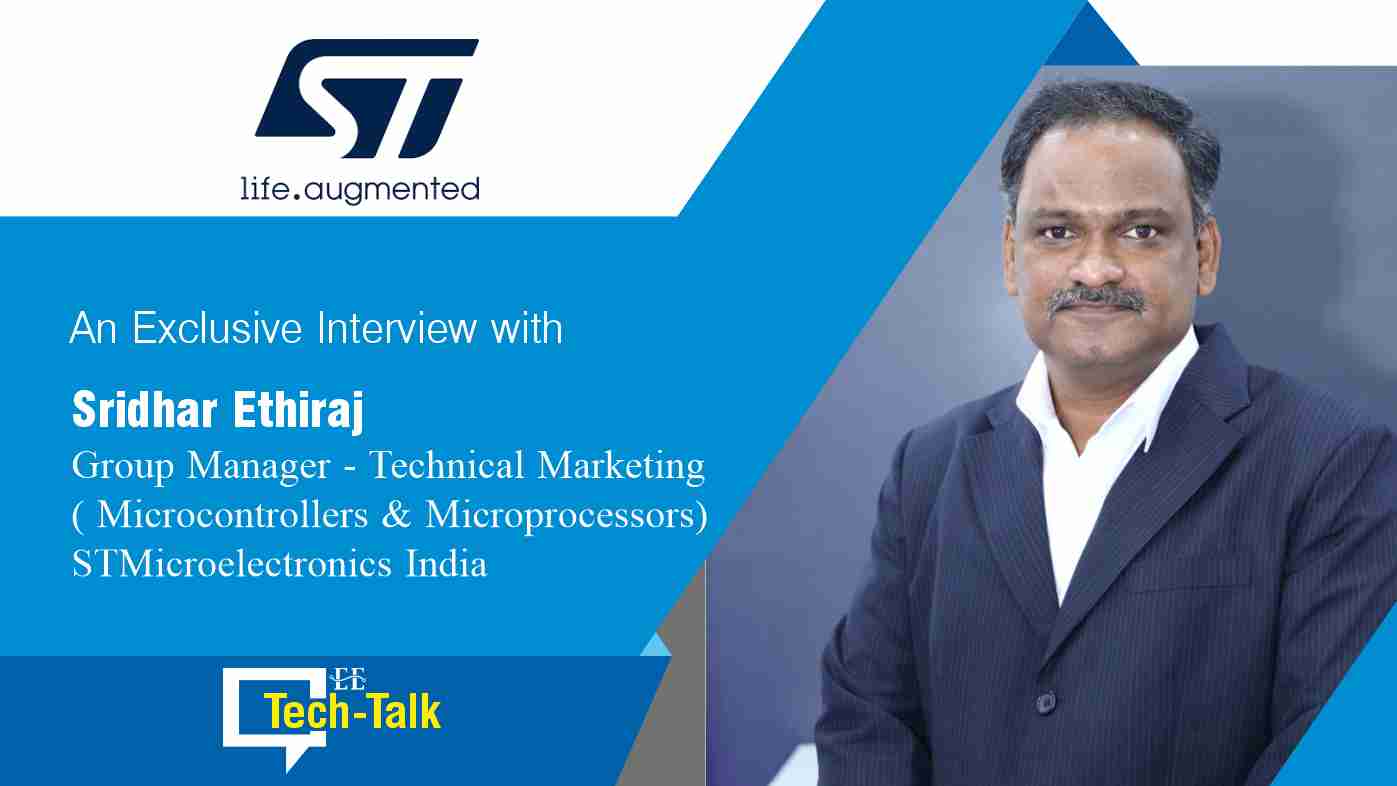
EE Editorial Team had an Exclusive Interaction with Sridhar Ethiraj | Group Manager Technical Marketing ( Microcontrollers & Microprocessors) | STMicroelectronics India
Electronics Era: Can you share the vision behind launching this new generation of entry-level STM32 microcontrollers? What market gaps are you aiming to address?
Sridhar Ethiraj: The vision behind the new STM325C series is to enhance the capabilities of the entry level microcontrollers while also continuing to resolve constraints and restrictions around size, cost and power. The goal is to boost the performance of billions of tiny smart devices across industrial, infrastructure and consumer applications.
STMicroelectronics is addressing a rather evident market gap, where developers require more advanced features, such as smoother control, better sensing and enhanced user experiences, without feeling the need to move to higher cost MCU platforms. The STM325C delivers the right sized performance and enables smart connected devices without over-engineering designs.
Electronics Era: How does this new STM32 series differentiate itself from previous entry-level offerings in terms of performance, power efficiency, and cost optimization?
Sridhar Ethiraj: STM325C differentiates itself through a combination of key features such as improved memory capacity, cost efficiency and higher performance. It is built on a proprietary 40nm process and leveraging the Arm Cortex-M33 core, it enables higher clock speeds and Flash memory up to 1MB, bringing with it capabilities, typically not available at the entry level.
In comparison with the traditional entry level MCU’s, it delivers faster task execution and supports more sophisticated features while maintaining low dynamic power consumption. At the same time, it remains cost-optimized, allowing developers to meet performance requirements without shifting to higher-end, more power-intensive MCU families.
Electronics Era: With increasing demand for edge intelligence, how are these entry-level MCUs positioned to support AI/ML workloads or smart embedded applications?
Sridhar Ethiraj: The STM325C is designed to support smart embedded applications by enhanced compute capability and memory availability. This enables functions such as real time control, sensor signal conditioning and noise suppression.
While the focus remains on improving embedded intelligence at the edge, there is also an emphasis on efficient execution of signal- processing and control workloads, rather than explicitly positioning the device for advanced AI/ML frameworks.
Electronics Era: Could you elaborate on the key architectural enhancements introduced in this new series?
Sridhar Ethiraj: Key architectural improvements in the STM32C5 include integration of the Arm Cortex- M33 core for an improved arithmetic and real time performance, use of ST’s 40nm process for better speed and cost efficiency, and expanded on-chip Flash (128KB up to 1MB). It also includes DMA- Direct Memory Access, with dual instances for parallel data handling, a simplified power architecture using a single LDO regulator, and built-in security features that comprise of cryptographic engines, memory protection, and support for secure boot and firmware updates.
Electronics Era: Can you discuss the development ecosystem—tools, software libraries, and support—that accompanies this new STM32 series?
Sridhar Ethiraj: This series is supported by an upgraded STM32Cube ecosystem, made to accelerate development and simplify the process of deployment. It includes STM32CubeMX and the new STMCubeMX2, with quicker access to reference code, code-size optimized HAL (HAL2) drivers, ready for production software libraries and examples, middleware support including FreeRTOS, LwIP, USBX, and FileX, and free development environments such as STM32CubeIDE and STM32CubeIDE for VS Code.
Electronics Era: In the context of India’s growing electronics manufacturing ecosystem, how do you see adoption of these MCUs evolving?

Sridhar Ethiraj: With its combination of performance and cost efficiency and integration, the STM32C5 allows the developers to design feature heavy products while tackling the restrictions of tight costs and power constraints. These make it specifically well suited for cost sensitive and high- volume applications that are central to the expansion of electronics manufacturing.
Additionally, the scalability of the STM32 ecosystem and the ability to reuse software across product lines allow manufacturers to streamline development and efficiently scale designs across multiple applications.
Electronics Era: How does this new STM32 family contribute to faster time-to-market for OEMs and product designers?
Sridhar Ethiraj: The STM32C5 contributes to faster time-to-market through a series of hardware integration and ecosystem support. Developers greatly benefit from reusable firmware across STM32 families, production-ready software examples, simplified hardware design because of higher integration, and access to evaluation boards and reference designs.
Electronics Era: With increasing integration of connectivity protocols, what communication interfaces are supported in this series?
Sridhar Ethiraj: The STM32C5 supports Ethernet connectivity with an integrated Ethernet MAC and RMII interface, enabling implementation with minimal external components (primarily an external PHY). It supports 10/100 Mbps Ethernet, suitable for industrial IoT, smart infrastructure, and control applications.
Electronics Era: How is STMicroelectronics enabling ease of design and rapid prototyping for engineers using these MCUs?
Sridhar Ethiraj: STMicroelectronics enables the ease of rapid prototyping and design, through STM32 Nucleo evaluation boards, hardware development tools and reference designs, extensive code example libraries, simplified PCB design due to integrated peripherals, like Ethernet MAC and the STM32Cube ecosystem for faster development and configuration. These tools help to reduce complexity in design and accelerate early- stage development.
Electronics Era: What sustainability or energy-efficiency considerations have been incorporated into the design of this new series?
Sridhar Ethiraj: The STM32C5 is built to deliver higher performance while parallelly maintaining strong energy efficiency, with low dynamic power consumption of less than 80 µA/MHz, enabling a smooth operation in power-constrained applications.
This efficiency is further enhanced by the use of a few architectural features, such as DMA, which heavily reduces the load on the CPU and optimizes system level power consumption, as well as a higher level of integration, that minimizes the need for external components, which in turn helps to reduce the usage of the overall system.
In addition, by combining higher performance with reduced bill-of-materials requirements, the STM32C5 further enables more efficient system design, supporting both energy and resource optimization in embedded applications.