


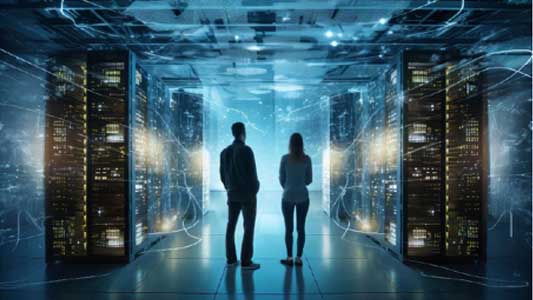
Imagine a factory that never sleeps, where the raw material is not steel or plastic, but information. Its production lines hum 24/7, not assembling physical goods, but powering the intelligent technologies that are reshaping our world. From the chatbots that answer our questions to the systems that recommend our next favorite movie, there is a physical heartbeat behind these digital services. This is the modern AI data center, and it represents one of the most significant infrastructural shifts of our time. It is the critical, tangible foundation that makes the magic of artificial intelligence possible, transforming endless streams of data into genuine, usable intelligence.
Forget the old image of a simple server room or a corporate data warehouse; AI data centers are a different beast entirely. They are the engine rooms for large language models, the training grounds for complex algorithms, and the delivery point for the AI tools we are starting to use every day. This is where the incredible computational power needed to run and train AI models lives. Let’s pull back the curtain and explore what makes these technological powerhouses tick, from their specialized hardware to their massive energy demands and their crucial role in building the future.
Beyond Simple Storage: The Specialized Role of an AI Data Center
So, what fundamentally sets an AI data center apart from its predecessors? It all comes down to its singular, specialized purpose. Traditional data centers were largely designed for data storage and retrieval, handling tasks like hosting websites, managing databases, or supporting enterprise software. These tasks require reliability and connectivity, but not necessarily immense, sustained computational power.
An AI data center, however, is built for one thing: processing. Its primary job is to perform trillions of calculations per second to either train new AI models or run existing ones, a process known as inference. This is a fundamental shift from a passive repository of information to an active, thinking engine.
Think of it as the difference between a library and a scientist’s laboratory. The library (traditional data center) is excellent for storing and retrieving information in a stable, organized manner. The laboratory (AI data center), however, is where active, powerful, and complex experiments are run non-stop. It is a dynamic, high-energy environment where new things are created and tested. This shift from storage to intense, continuous computation dictates everything about the facility, from the specialized, cutting-edge hardware inside to the very design of the building, its power grid, and its cooling systems.
The Powerful Engine: Hardware Built for AI
The extraordinary demands of AI processing require a completely new class of hardware. You cannot power a Formula 1 car with a standard engine, and you cannot run advanced AI models with standard computing chips. The entire technological stack within an AI data center is engineered for a single goal: unprecedented speed and parallel processing power.
AI Accelerators – The Supercomputing Heart: The undisputed superstars of the AI data center are specialized processors known as AI accelerators. The most common of these are GPUs, or Graphics Processing Units. Originally designed to render complex visuals for video games by performing millions of calculations simultaneously, this inherent architecture makes them perfectly suited for the parallel processing demands of AI. Training a sophisticated large language model is not a sequential task; it requires working on countless pieces of data at the same time. This can require thousands of these GPUs, linked together, working in concert for weeks or even months, consuming vast amounts of electricity in a continuous cycle of computation and learning.
Advanced Networking – The Central Nervous System: With thousands of high-powered processors working on a single, massive problem, they need to communicate with each other—and they need to do it incredibly fast. Any delay or bottleneck in this communication can bring the entire training process to a crawl. This is where specialized, high-speed networking equipment comes in. It forms a central nervous system for the data center, connecting all the individual chips into one cohesive supercomputer. This network allows the processors to share data and intermediate results almost instantaneously, ensuring they can work in perfect sync. The speed of this internal network is just as critical as the speed of the individual processors themselves.
The Memory and Storage Layer – Feeding the Beast: AI models are voracious consumers of data. They are not just processing live information; they require access to enormous training datasets that can be petabytes in size equivalent to millions of gigabytes. Furthermore, during computation, the model’s parameters, which can number in the trillions, must be held in high-speed memory. This creates a two-tiered demand: enormous, fast storage to access the raw training data, and massive amounts of high- bandwidth memory to hold the model’s state during active calculation. Fast storage and memory are crucial to keep the powerful processors continuously fed with data; if the processors have to wait for data, their immense power is wasted, a costly inefficiency at this scale.
The Invisible Challenge: Powering and Cooling the Beast
The sheer power consumption of an AI data center is one of its most defining and challenging characteristics, fundamentally separating it from earlier computing infrastructure. The scale is almost difficult to comprehend. A single, high-performance AI accelerator chip can consume more power than an entire rack of servers in a traditional data center. When you scale this up to a large-scale facility housing hundreds of thousands of these chips, the total electricity usage can be on par with the power consumption of a medium-sized city. This creates a dual challenge that dominates the design and operation of these facilities: sourcing enough reliable power and managing the intense heat that all this energy inevitably produces.
Cooling is not a minor side issue or a supporting function; it is a central, critical design problem that dictates the feasibility of the entire operation. The laws of physics are unforgiving: all the electrical power pumped into the computing hardware is converted into heat. If the heat generated by these powerful chips is not managed effectively and continuously, they will overheat and suffer catastrophic failure in a matter of minutes.
Consequently, a huge portion of a data center’s total energy bill and a massive amount of its engineering effort is dedicated solely to cooling.
Companies are being forced to explore innovative and sometimes radical solutions to this thermal challenge. Many are moving beyond traditional air conditioning to direct liquid cooling systems, where servers are either sprayed with a non-conductive coolant or even fully submerged in special baths that draw heat away far more efficiently than air ever could.
Other strategies involve strategic geographical placement, locating new data centers in cooler northern climates to leverage natural “free cooling” from the outside air for a significant portion of the year, thereby drastically reducing the energy required for mechanical cooling.
The Blueprint of Intelligence: How AI Uses These Centers
So, what is all this infrastructure actually doing? What does the work of an AI data center look like on a practical level? The computational work is typically split into two distinct but equally demanding phases: training and inference. Both are incredibly resource-intensive, but they place different kinds of demands on the hardware and power systems.
The first and most demanding phase is AI Training. This is the foundational process of creating an AI model from scratch. Imagine the process of educating a student, but on a gargantuan, almost unimaginable scale. Instead of reading a few textbooks, the AI model is fed vast, curated datasets encompassing text from millions of books and websites, billions of images, or lines of code. Through a repetitive process of trial and error, the model continuously adjusts its billions or trillions of internal parameters, slowly learning the underlying patterns, grammar, and relationships within the data.

This training process requires a massive cluster of GPUs often thousands of them to run continuously for long periods, consuming immense amounts of electricity as the model iteratively improves its accuracy. A single training run for a state-of-the-art model can take weeks and cost millions of dollars in computing power alone. This is the most computationally expensive task in the world of computing today.
The second phase, which follows successful training, is Inference. Once a model is fully trained and its parameters are set, it is ready for practical use. Inference is the process of using that trained model to make predictions, answer questions, or generate new content. When you ask a conversational AI a complex question, it is the inference process running on the hardware in a data center that analyzes your query and formulates a coherent answer in real-time. While a single inference request requires significantly less computational power and energy than the original training process, the scale is what matters. Serving millions of users simultaneously, each making multiple requests, creates a massive and constant computational load that requires its own extensive and highly reliable infrastructure.
The Future of AI’s Foundational Infrastructure
As AI models grow larger, more complex, and more integrated into every facet of society, the demands on data centers will only intensify. The current trajectory points toward models with orders of magnitude more parameters, requiring even more powerful and efficient hardware. The race is already on to develop the next generation of AI chips that deliver greater performance while managing power consumption more effectively.
Simultaneously, the industry is grappling with the sustainability challenge. The enormous energy appetite of AI data centers is drawing scrutiny from governments, environmental groups, and communities. This is driving a massive push toward innovation in two key areas: energy sourcing and cooling efficiency. The future will see an increased focus on powering these centers with renewable energy, such as solar and wind, to mitigate their carbon footprint. Furthermore, advanced cooling technologies, like the liquid immersion systems mentioned earlier, will become standard rather than experimental.
The evolution of the AI data center is a critical story that will run parallel to the evolution of artificial intelligence itself. Breakthroughs in AI capabilities will be inextricably linked to breakthroughs in the infrastructure that supports them. We are likely to see the rise of even more specialized facilities, perhaps some dedicated solely to training while others are optimized for high-volume inference, each with hardware and architectures fine-tuned for their specific task.
The Indispensable Foundation of a New Era
These facilities are far more than just buildings full of computers. They are the indispensable foundation of the AI era, the physical manifestation of our digital intelligence. Every breakthrough in artificial intelligence, every new application that changes an industry, and every smart tool that enhances our daily lives is made possible by the relentless, humming activity within an AI data center.
They are the modern-day power plants for the information age, converting raw data into actionable insight and creative power. As AI continues to weave itself into the fabric of our economy and daily routines, understanding these engines of intelligence becomes crucial. They are the unsung heroes, the massive, powerful, and complex factories of the mind that are quietly, yet undeniably, powering the future.