



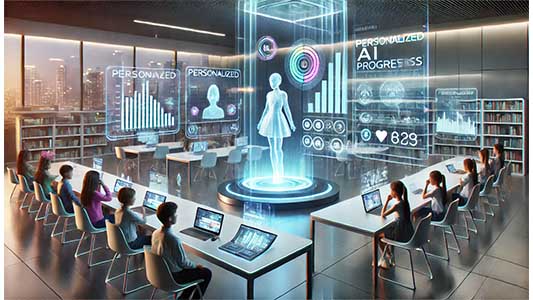
The classroom is undergoing one of the most profound transformations in its history, shifting from a static environment of one-way instruction to a dynamic

CEO of Solitaire Brand Business
learning space where intelligence, adaptability, and participation define the experience. This evolution is being shaped by the convergence of artificial intelligence, immersive interactivity and the next generation of digital boards, which together are redefining how knowledge is delivered, absorbed and applied.
Education systems across the world are being challenged to prepare students not merely for examinations, but for a future that demands critical thinking, collaboration, creativity, and continuous learning. Organizations like UNESCO have consistently emphasized the role of digital tools in building inclusive, resilient and future-oriented education systems, where technology strengthens access, improves learning outcomes, and supports the shifting needs of students in an increasingly complex global environment.
Digital boards today are no longer simple display surfaces that mirror traditional teaching methods but are rapidly evolving into intelligent learning companions that combine artificial intelligence, collaborative software, and real time analytics within a unified classroom experience. These systems can now observe engagement patterns, highlight conceptual gaps, and support differentiated instruction by helping educators adjust pace, depth, and delivery based on how students are responding. This does not diminish the role of the teacher but strengthens it by transforming the classroom into a responsive ecosystem where instruction becomes more precise, adaptive, and outcome focused.

Interactivity has emerged as the new language of learning, replacing passive content consumption with active knowledge creation. Touch-enabled boards, shared workspaces, live simulations and collaborative problem-solving experiences now allow students to engage directly with concepts rather than simply observe them. When learners manipulate information, test ideas in real time and co-create solutions with peers, the classroom becomes a participatory environment that strengthens comprehension, retention and higher-order thinking skills.
One of the most meaningful impacts of intelligent learning spaces lies in their ability to improve equity and accessibility. Features such as real time translation, speech to text support, adaptive visual interfaces and personalized content pathways can help bridge linguistic, cognitive and regional divides. In diverse education ecosystems where classrooms reflect wide cultural, economic, and learning variations, Intelligent Digital Interactive Boards have the potential to act as powerful equalizers by ensuring that quality learning experiences are not limited by geography, language, or ability.
As classrooms become increasingly data-rich, questions of ethics, privacy, and governance become central to the sustainability of this evolution. Every interaction generates insight into learning behavior, attention and performance, which places a significant responsibility on institutions and technology providers to ensure strong safeguards, transparent data use practices and well-defined consent structures. The success of intelligent classrooms will depend not only on technical advancement but also on the trust that students, parents, and educators place in these systems.
The long-term impact of this transformation will ultimately be shaped by how effectively teachers are empowered to use intelligent tools. Technology on its own cannot drive change unless it is supported by continuous professional development, intuitive system design, and a culture of digital confidence among educators. Teachers are evolving into facilitators of inquiry, mentors of exploration and designers of learning experiences, and their comfort with intelligent classrooms will determine how meaningfully these tools are integrated into everyday teaching practice.
The classroom of the future will not be defined by a single piece of hardware but by an integrated ecosystem where intelligent displays, adaptive content, secure digital frameworks, and human-centered tutoring work in harmony. The next generation of learners will grow up in environments where exploration replaces memorization, where learning adapts to individual potential, and where classrooms support both academic growth and cognitive maturity.
The responsibility before education leaders today is not simply to adopt advanced technologies but to shape them with foresight, inclusivity and ethical clarity so that the future of learning spaces is designed to elevate human potential rather than merely automate instruction.