

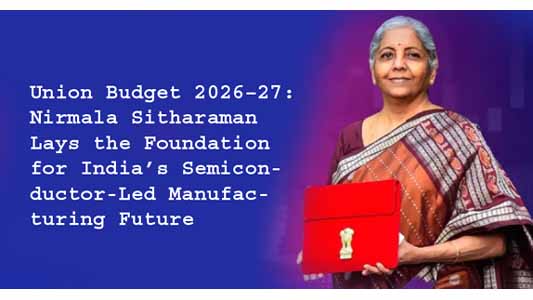
Presenting the Union Budget 2026–27 in Parliament today, Finance Minister Nirmala Sitharaman outlined a clear and forward-looking roadmap to strengthen India’s manufacturing, clean mobility, and technology ecosystems. With a strong emphasis on semiconductors, electronics manufacturing, clean energy, critical minerals, and skills, the Budget positions these sectors as central pillars of India’s journey towards Viksit Bharat and long-term economic resilience.
Among the most significant announcements is the transition to India Semiconductor Mission (ISM) 2.0, backed by an enhanced outlay of ₹40,000 crore, marking a decisive shift from a fabrication-only approach to a full-stack semiconductor ecosystem strategy.
What’s New for the Semiconductor Industry
The Union Budget 2026–27 expands the scope of India’s semiconductor ambition in three key ways:
- Beyond fabs to full-stack capability
ISM 2.0 now includes incentives for domestic manufacturing of semiconductor equipment, chemicals, gases, wafers, and materials, reducing dependence on imports and strengthening supply-chain resilience. - Stronger component ecosystem
The allocation for the Electronics Components Manufacturing Scheme has been increased to ₹40,000 crore, up from ₹22,919 crore, supporting PCBs, modules, sub-assemblies, and precision electronics essential for semiconductor-led manufacturing. - Focus on research, tools, and skills
The Budget proposes industry-led research and training centres, high-tech tool rooms, and academic zones around industrial corridors—creating a direct pipeline between education, R&D, and advanced manufacturing.
According to Mr. Rajendra Chodankar, Founder and Chairman, RRP Electronics Ltd, this shift marks a critical inflection point for the industry.
“The transition to ISM 2.0 expands the mission beyond fabrication to include domestic production of manufacturing equipment and essential materials. For companies like RRP Electronics, the focus on developing full-stack Indian IP positions the industry to move from assembly and testing into chip-level design and intellectual property ownership.”
Clean Energy, EVs and Semiconductor Demand
The Budget also reinforces the interlinkage between clean mobility, renewable energy, and semiconductor demand. With continued duty exemptions on capital goods for battery manufacturing, targeted incentives for localisation, and strong capex support, the government is accelerating EV adoption while strengthening domestic value chains.

Mr. Jalaj Gupta, Managing Director, Montra Electric, highlighted the integrated nature of the approach:
“From lithium-ion cell manufacturing and rare earth processing to strengthening semiconductor and electronics ecosystems through ISM 2.0, the government is enabling a truly integrated EV supply chain. These initiatives will deepen localisation and reinforce India’s position as a global hub for sustainable mobility.”
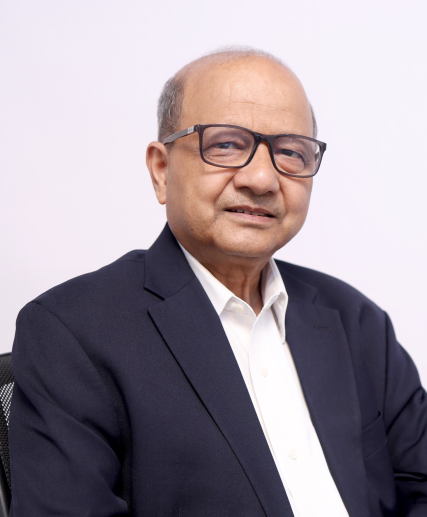
Similarly, Mr. Vinod Aggarwal, MD & CEO, VE Commercial Vehicles, pointed to the strategic importance of infrastructure and critical minerals:
“The emphasis on developing Rare Earth Mineral Corridors across multiple states is a decisive step toward securing critical inputs for electric motors and advanced components, reducing import dependence and strengthening domestic value chains.”

Mr. Tarun Garg, MD & CEO, Hyundai Motor India
Further building on the mega GST 2.0 reforms, the Union Budget 2026–27 presents a long-term focused roadmap that accelerates India’s rise as a global manufacturing hub and Atmanirbhar Bharat. Focus on the rare earth corridor, EV Battery and Electronics manufacturing, MSME empowerment, inclusivity and AI investments position India for global leadership. The strong push for tourism, rural growth and enhanced regional connectivity will further spur economic activity and open new avenues for advanced mobility, logistics and transportation solutions. With a bold capital outlay, simplified taxation and improved ease of doing business, this Budget is a decisive step towards a healthy and Viksit Bharat, reinforcing confidence in India’s growth story.

Commenting on the Budget, Vikrampati Singhania, President, ACMA and Vice Chairman & Managing Director, JK Fenner (India) Limited, said-
The Automotive Component Manufacturers Association of India (ACMA) welcomes the Union Budget 2026–27 presented by the Hon’ble Finance Minister, Smt. Nirmala Sitharaman, and commends the Government for a pragmatic and forward-looking budget that reinforces India’s manufacturing priorities, export competitiveness and technology transition.
The continued focus on manufacturing and MSMEs, including measures to improve access to credit, promote scale and enhance productivity, is encouraging for the auto component industry. These steps will support capacity expansion and enable sustained investments in technology and innovation, which are critical for global competitiveness.
ACMA also welcomes the emphasis on advanced manufacturing, clean-energy technologies and domestic value chains for electric mobility and auto electronics. Support for localisation of critical components such as batteries, power electronics and high-value electronic systems will strengthen supply-chain resilience and reduce import dependence.
The focus on exports, trade facilitation and logistics efficiency is timely, particularly in the context of global trade uncertainties. Measures to improve access to export credit and address non-tariff barriers will further integrate Indian auto component manufacturers into global supply chains and reinforce India’s position as a reliable sourcing hub.
The industry appreciates the steps towards rationalisation of customs duties, correction of inverted duty structures and procedural simplification, which will lower costs and improve ease of doing business.
Commenting on the Budget, Vikrampati Singhania, President, ACMA and Vice Chairman & Managing Director, JK Fenner (India) Limited, said, “The Union Budget 2026–27 lays a clear and credible roadmap for strengthening India’s manufacturing ecosystem. The sustained focus on MSMEs, clean mobility, and export facilitation will help the auto component industry navigate global headwinds while positioning India as a competitive and trusted manufacturing and sourcing destination.”
ACMA looks forward to continued engagement with the Government to support effective implementation of the Budget proposals and to further strengthen the auto component industry as a key pillar of India’s industrial and export growth.
Atria Renewable Karthik Raju
“The Union Budget 2026–27, presented by the Hon’ble Finance Minister Smt. Nirmala Sitharaman on 1 February 2026, marks a decisive step in strengthening India’s renewable energy ecosystem and domestic clean-tech manufacturing. Notably, the exemption of basic customs duty on sodium antimonate used in the manufacture of solar glass will materially reduce input costs for solar manufacturers and enhance the competitiveness of India’s solar value chain. In addition, the extension of basic customs duty exemptions on capital goods used for manufacturing lithium-ion cells to include Battery Energy Storage Systems (BESS) is a timely and strategic move.
Together with broader fiscal incentives, a sustained focus on capital expenditure, and continued duty rationalisation, these measures reflect the Government’s strong commitment to ‘Make in India’ in the clean energy sector, while advancing India’s net-zero ambitions and long-term energy security goals.
By easing cost pressures on critical raw materials and encouraging deeper localisation, the Budget reinforces investor confidence and supports innovation and scale-up across solar manufacturing and allied clean energy technologies. At a time of ambitious capacity targets and rapidly evolving market dynamics, these targeted interventions will enhance the economic viability of solar deployment and accelerate India’s transition to a resilient, affordable, and sustainable energy future.”

Post Budget quote by Mr. Arif Aga, Director at SgurrEnergy
“The strong emphasis on capacity building through the National Centres of Excellence for Skilling—including collaborations in sectors like renewable energy—is vital for equipping the nation with the specialized workforce needed to deploy large-scale solar, wind, green hydrogen, and other clean energy projects, while optimizing renewable energy generation and integration.
This commitment will play a key role in achieving India’s target of 500 GW capacity by 2030, all while ensuring cost efficiency and supporting the broader transition to a sustainable, low-carbon energy future.”

Mr. Praveen Kakulte, Founder and CEO of POWERCON Group
“The Union Budget 2026–27 sets the stage for India to achieve energy security, climate goals, and a future-ready, low-carbon economy. With a ₹20,000 crore allocation for Carbon Capture and Storage technologies, the government signals strong financial and policy support to reduce greenhouse gas emissions, particularly carbon dioxide from coal-based power, transport, and industry. The focus on scaling renewables i.e. wind, solar, and battery technologies alongside energy storage systems aims to address the current gap between installed power capacity and actual energy generation, strengthening reliance on non-fossil fuel sources. While conventional fuel sources continue to stay, these measures pave the way for a cleaner, more reliable energy mix.
‘Inclusivity’ through MSMEs and women entrepreneurs from the tier-2 & tier-3 sector, this budget motivates the Power sector while creating avenues to lit every Indian home with clean, reliable and affordable energy!”

Mr. Kunal Mundra, Founder and CEO, Astranova Mobility
“This budget has highlighted the government’s emphasis on enabling financing for India’s future and the critical role specialised NBFCs play in the ecosystem. The Budget acknowledges that banks are not the only answer to India’s financing needs and that complex, niche industries require specialised financing institutions that offer more than simply credit, by truly comprehending the asset lifecycle. This shift moves financing away from one-size-fits-all lending towards more focused, developmental support. For companies working in clean mobility, this is a very encouraging signal and reinforces the fact that enabling India’s energy transition will require specialised financing institutions like Astranova Mobility with the required capabilities to enable deep financing penetration and hence faster adoption.”
Rare Earths, Defence and Strategic Electronics
A major structural reform announced in the Budget is the creation of Rare Earth Mineral Corridors across Odisha, Kerala, Andhra Pradesh, and Tamil Nadu—critical for semiconductors, EV motors, aerospace, and defence electronics.

Subbu Venkatachalam, Head – Defence & Aerospace, Carborundum Universal Limited, called this a timely boost:
“The recognition of critical minerals and materials science as core enablers of aerospace and defence will ensure domestic manufacturers can rely on a robust ecosystem for mining, processing, research, and manufacturing within the country.”
The Budget’s customs duty exemptions for MRO-related raw materials and the push for domestic aviation and defence manufacturing further strengthen India’s strategic electronics ecosystem.


Gopalan Aerospace director C Prabhakar
“The proposed Budget highlights the exemption of basic customs duty on raw materials for defence aircraft parts and components used in civilian training aircraft, marking a meaningful boost for India’s aerospace sector. These measures will help reduce costs across maintenance, repair, and manufacturing, while advancing the country’s objective of achieving self-reliance in both military and civil aerospace.
Such initiatives provide a strong platform for companies like Gopalan Aerospace to accelerate innovation, scale indigenous manufacturing capabilities, and contribute to positioning India as a globally competitive aerospace hub.”
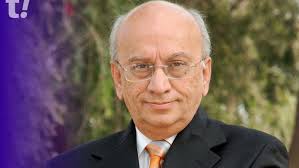
Deepak Pahwa – Chairman, Pahwa Group & Managing Director, BryAir
“Budget 2026 marks a structural shift in India’s semiconductor strategy by recognising that scale without sustainability is not globally competitive. With India Semiconductor Mission 2.0 and a proposed Rs 40,000 crore outlay for electronics manufacturing, the focus now moves beyond capacity creation to process excellence. Semiconductor plants are among the most energy and environment intensive manufacturing units, making energy efficiency, contamination control and decarbonisation non-negotiable. India’s real advantage will come from building fabs that are cleaner, more efficient and cost-competitive by design. This approach will determine whether India becomes a serious semiconductor manufacturing hub or merely an assembly destination.”
MSMEs, Skills and Ecosystem Development
Beyond capital investments, the Budget places strong emphasis on MSMEs, supplier ecosystems, and skills development, including a ₹10,000 crore MSME Growth Fund and enhanced support for self-reliance initiatives.

Mr. Benjamin Lin, President, Delta Electronics India, said the policy framework strikes the right balance:
“By aligning capital support with capability building and innovation, the Budget creates a solid foundation for sustainable, technology-led growth and reinforces India’s ambition to become a globally competitive electronics manufacturing hub.”

Mr. Niranjan Nayak, MD, Delta Electronics India
What stands out in Union Budget 2026 is the scale, consistency, and seriousness with which the government is approaching electronics and advanced manufacturing. The launch of India Semiconductor Mission 2.0 with an outlay of ₹40,000 crore, along with the expansion of the electronics components manufacturing scheme to a similar level, clearly signals a long-term commitment to building strong domestic capabilities. Importantly, the focus goes beyond manufacturing capacity to include full-stack design, development of Indian intellectual property, skill creation, and stronger supply-chain resilience. This reflects a practical understanding of how globally competitive technology ecosystems are built. Such clarity and continuity in policy direction give industry the confidence to plan long-term investments, deepen local value addition, and steadily move India up the electronics manufacturing value chain.

Mr. Guruprasad Mudlapur, Vice Chairman, CII Karnataka state council, President of Bosch India and Managing Director of Bosch Ltd,
“The 2026 Union Budget has focused on both incentives and long-term reforms. The budget needs to be viewed in the context of current global economic conditions and should be balanced based on what the global economic situation requires.
So, it cannot be taken in isolation. Policymaking has to consider both the present year and the coming years. We cannot look at each year separately. I think this budget has tried to balance all these aspects, keeping the current global economic environment in mind.
Overall, it is quite balanced. A lot of incentives have been introduced, and many of them have been enhanced. India is also positioning itself among leading global economies.
For example, the Production-Linked Incentive (PLI) schemes, semiconductor incentives, and specific measures for strengthening supply chains, logistics, transport, and critical components are all aimed at boosting domestic manufacturing. Hence, in my view, this is a balanced budget.”

From a skills perspective, Mr. Saleem Ahmed, Officiating Head, ESSCI, described the Budget as a defining moment:
“ISM 2.0 and the expanded electronics components scheme will significantly reshape skill requirements across the semiconductor value chain. This creates a critical opportunity to build a future-ready workforce in chip design, advanced packaging, testing, and electronics manufacturing.”

Mr. Tadashi Chiba, MD & CEO, Panasonic India,
“The Government’s consistent focus on infrastructure continues to be central to India’s growth agenda. The Union Budget 2026–27, with capital expenditure increased to ₹12.2 lakh crore, reaffirms infrastructure as the backbone of India’s economic expansion. This sustained push will directly support the scaling of Panasonic’s advanced B2B solutions and offerings, which are integral to large-scale infrastructure development. The continued focus on strengthening India’s manufacturing ecosystem through ECMS and the exemption of basic customs duty on select electrical appliances, including microwaves, is a timely measure that will improve cost efficiencies, encourage domestic value creation, and boost market adoption.
The emphasis on the strategic deployment of cutting-edge technologies, including AI, to improve governance and productivity, will lay a strong foundation for inclusive, sustainable, and people-centric growth in India.”

Mr. Nakul Kundra, CEO & Co-Founder, Devnagri
“The Union Budget 2026 strengthens the Government’s initiative to make technology, especially AI, a core driver of India’s next growth phase. Equally encouraging is the Budget’s emphasis on applied technology adoption, from AI-driven customised advisory tools and multilingual platforms like Bharat Vistar, to the use of AI for more efficient, transparent along with data-driven governance and is highly celebrated and reflects a strong commitment to integrating such initiatives at scale. Initiatives such as the ₹10,000 crore MSME Growth Fund and the renewed focus on cities as growth engines can meaningfully democratise AI beyond large enterprises, particularly across manufacturing and public services. That said, real impact will depend on execution, specifically lowering compute costs, expanding domestic data-centre capacity, enabling language-first AI systems, and building high-quality Indian datasets anchored in data dignity, consent, and trust.”

Nikita Kumawat, Co-Founder and Executive Director, Brandworks Technologies
“Union Budget 2026 marks a significant change in India’s electronics and semiconductor journey, shifting the focus from capacity creation to long-term capability development. The introduction of the Indian Semiconductor Mission 2.0 and the launch of the Shakti initiative, coupled with an enhanced financial outlay of Rs 40,000 crore, further strengthen the ecosystem and reflect the government’s commitment to building a future-ready ecosystem across equipment, materials, full-stack IP, and resilient supply chains.
The focus on domestic component manufacturing, R&D, and workforce upskilling is a critical step towards strengthening India’s position in the global electronics value chain. These measures will reduce import dependence and create the foundation for innovation-led, sustainable growth.India’s next phase of progress will be driven by companies that integrate design, engineering, and advanced manufacturing at scale, for which Budget 2026 lays the groundwork. This transition reinforces India’s ambition to emerge as a global hub for electronics and semiconductor innovation.”

Mr. Raghav Gupta, Founder & CEO, Futurense
The introduction of the Capacity Building AI Missions for 25 crore people, along with support for the National Quantum Mission, Anusandhan Research Fund, and the R&D and Innovation Fund, signals a long term commitment to creating both the talent and the infrastructure required for an AI-native economy. This is not just an investment in technology but an investment in people. By expanding access to advanced learning and accelerating innovation pathways, the Budget lays the groundwork for a workforce that can build, deploy and lead with AI across global industries. It opens the door for deeper industry, academia collaboration and a future defined by capability, confidence, and opportunity.”
Mr. Kishan Sundar, SVP and Chief Technology Officer, Maveric Systems
“Union Budget 2026 makes it clear that AI and IT services will play a central role in shaping the next phase of India’s banking and financial services growth. As credit demand remains strong and banks operate under tighter funding and regulatory conditions, the emphasis on digital infrastructure, AI-led innovation and technology-enabled productivity is both timely and necessary.
The Budget’s focus on strengthening IT services and deepening digital capabilities provides added momentum for banks to accelerate AI adoption across credit decisioning, risk management, compliance and customer engagement. With increasing system complexity and scale, AI-driven automation and data-led decisioning are becoming essential for banks to grow responsibly while improving efficiency and resilience. Overall, the Budget reinforces technology as a foundational pillar for sustainable growth in the banking ecosystem.
“Budget 2026–27 reinforces India’s intent to lead in the AI age by putting talent and capability building at the centre of national progress. The government’s three Kartavya – driving growth, strengthening people’s capacity and ensuring opportunity for all align strongly with the direction in which the technology ecosystem is moving.

Mr. Vineet Agarwal, Managing Director, Transport Corporation of India Limited (TCI)
“The Union Budget 2026–27 sends a strong and reassuring signal on India’s manufacturing-led growth agenda. By maintaining fiscal discipline with a deficit of 4.3% while scaling capital expenditure to ₹12.2 lakh crore, the Government has reinforced confidence in long-term investments, capacity creation, and a stable, predictable policy environment that strengthens ease of doing business. The Budget’s sharp focus on logistics and industrial infrastructure will be a major enabler of manufacturing scale-up. Dedicated freight corridors, expansion of national waterways, high-speed rail connectivity, investments in ship-repair ecosystems, and a ₹10,000-crore push for container manufacturing will ignificantly reduce logistics costs and build a robust ecosystem for capital goods and supporting industries. These measures will strengthen MSMEs, crowd in private investment, and generate large-scale employment across manufacturing, logistics, and tourism-linked services. Equally important is the forward-looking emphasis on advanced manufacturing through ISM 2.0, semiconductors, data centres, and AI-led digital platforms. Together, these initiatives lay the foundation for resilient, technology-driven supply chains and position India as a globally competitive hub for manufacturing, trade, tourism, and job creation—aligned with the broader vision of Viksit Bharat.”.

Mr. Sanjay Chitkara, Co-CSMO, LG Electronics India Limited
The Union Budget 2026 reinforces India’s ambition to become a global high-tech manufacturing hub through higher capital investment, Semiconductor Mission 2.0, and expanded support for electronics component manufacturing. Measures such as duty exemptions, MSME funding, and improved infrastructure will strengthen supply chains and enhance industry competitiveness. For companies like
LG Electronics, this creates a stronger ecosystem for localized manufacturing, innovation, and long-term growth. At the same time, tax rationalization and policies aligned with middle-class needs will boost consumption and job creation, delivering balanced growth for both industry and citizens.

Aimtron Electronics chairman and MD Mukesh Vasani’s
“The Union Budget meaningfully advances the vision of Viksit Bharat by strengthening India’s electronics and semiconductor manufacturing backbone. The ₹40,000 crore allocation for electronics components and semiconductors will directly benefit Aimtron by improving domestic availability of semiconductor-linked components, reducing import dependence, and enabling faster scale-up of our EMS, PCB assembly, box-build, and system integration operations serving India, the US, and global customers. Coupled with the SME Growth Fund and logistics-led infrastructure investments, the budget reinforces India’s role as a trusted, export-ready manufacturing hub, aligning closely with Aimtron’s India–US growth strategy.”

Mr. Amit Khatri, co-founder, Noise
“The Union Budget 2026 sets a clear direction towards Viksit Bharat, anchored in inclusive growth, global competitiveness, and a strong push to accelerate India’s next phase of economic expansion. As a growing economy with expanding trade and capital needs, India’s continued integration with global markets through exports and long-term investment, combined with a strong focus on technology-led manufacturing, sends a decisive signal of intent to position the country as a global leader in electronics and innovation.
The scaling up of the electronics components manufacturing scheme to ₹40,000 crore further reinforces India’s ambition to emerge as a world-class hub for consumer electronics. For high-growth categories such as smart wearables and audio, this will help reduce supply-side dependencies, improve speed-to-market, and enable companies to design, innovate, and manufacture at scale within the country.
At Noise, we are already seeing the impact of this direction on the ground. With nearly 95% of our products made in India and growing PCB localisation, we have built an integrated design-to-manufacturing ecosystem that allows us to innovate and scale from India. The policy clarity and long-term commitment outlined in this budget will further strengthen our ability to deepen local value creation and build globally benchmarked consumer technology from India, for the world.”

Mr. Anil Rai Gupta, Chairman & MD, Havells India
“We commend and congratulate the Government of India for presenting a progressive and industry-focused Union Budget 2026–27 that strengthens India’s journey toward self-reliance and global competitiveness. The proposed capital expenditure of ₹12.2 lakh crore, alongside measures to mobilise private investment through the Infrastructure Risk Guarantee Fund, accelerated CPSE real estate monetisation via REITs, and development of dedicated freight corridors with sustainable cargo focus, will accelerate execution across housing, commercial, industrial, and logistics projects.
Key interventions such as the expansion of the Electronics Components Manufacturing Scheme from ₹22,999 crore to ₹40,000 crore, the ₹10,000 crore, five-year initiative to promote domestic container manufacturing, and rationalisation of customs duties to correct inverted structures reflect a decisive push towards localisation and technology-led manufacturing. These measures are expected to drive capacity creation, strengthen supply chains, and enhance India’s competitiveness across critical industrial sectors.
By advancing the ‘Make in India’ agenda through sustained policy support, targeted investments, and focus on industrial competitiveness, this Budget lays a robust foundation for resilient, inclusive, and technology-driven growth across India’s industrial landscape.”
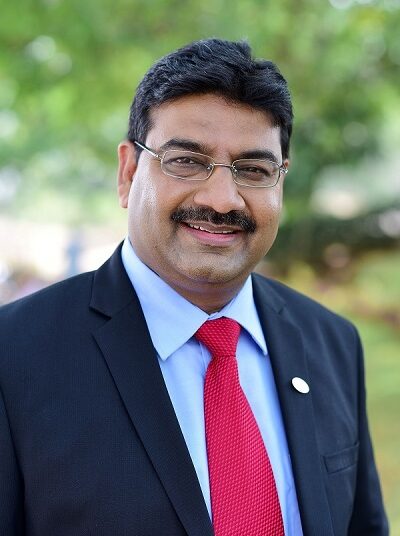
Mr. S Sunil Kumar, Country President, Henkel Adhesives Technologies India
“We welcome Union Budget 2026 and its focus on the three Kartavyas of accelerating growth, building national capacity, and ensuring inclusive development. The continued emphasis on infrastructure is reflected in the ₹12.2 lakh crore public capital expenditure. Investments in transport corridors, urban infrastructure, capital goods, electronics manufacturing, and semiconductors signal a clear intent to build deeper, more resilient manufacturing capabilities. For the adhesives sector, this supports demand across infrastructure-led and technology-intensive applications. These range from infrastructure and transportation to electronics and semiconductor manufacturing, where performance, durability, and reliability are critical.
Henkel’s strategic focus on innovation, digitalisation, and sustainability is well reflected in the Budget’s emphasis on sustainability, digital manufacturing, advanced electronics, and Semiconductor Mission 2.0. The ₹20,000 crore allocation for carbon capture and utilisation further signals that sustainability is being treated as an economic enabler rather than a compliance requirement. Taken together, the Budget underscores a responsible growth framework anchored in inclusivity, capability building and long-term competitiveness, and we would like to credit the government for this.”

CCUS Push Signals India’s Next Phase of Industrial Decarbonisation
Mr. Yashodhan Ramteke, Chief Executive Officer & Director, EcoGuard Global.
With the Union Budget announcing a commitment of ₹20,000 crores over five years to Carbon Capture, Utilisation and Storage (CCUS), we see a major shift in the way the country is planning to address the challenge of decarbonisation in sectors such as power, steel, cement, refineries, and chemicals. The scheme has the potential to take CCUS from the pilot stage to a viable industrial solution, which would be beneficial in reducing transition risk in the country’s journey towards the development of its domestic carbon market. Post the renewable energy push that resulted in achieving our NDC targets earlier than anticipated, the next focus area naturally flows into CCUS which will help the country to decarbonize its hard to abate sectors.
This move also provides a strong base to the green economy of the country by allowing the reduction of emissions without impacting the level of industrial output, which is critical to maintaining the country’s global competitiveness. With the country increasingly aligning itself to the European Union’s carbon standards, investments in CCUS, MRV technologies, and outcome-based incentives would make the country’s industry not only ‘decarbonisation-ready’ but also ‘market-aligned,’ which would be critical to the country’s Net Zero ambitions.”
Conclusion– A Strategic Shift Toward Semiconductor Leadership
Taken together, the Union Budget 2026–27 signals a strategic shift—from scale alone to capability, resilience, and long-term competitiveness. By integrating semiconductors with clean energy, mobility, defence, materials, and skills, the government has laid the groundwork for India to emerge not just as a manufacturing base, but as a trusted global partner in advanced electronics and semiconductor innovation.
As India moves deeper into the digital and green economy, the success of ISM 2.0 and allied schemes will be central to shaping the country’s technological and economic future.