


As global data center build-out accelerates, co-packaged optics (CPO) is being manufactured at a scale the industry hasn’t previously faced, and a key step of photonic packaging has moved to the center of the conversation: active alignment. The discussion below reflects how active alignment has become a yield-and-throughput problem in its own right, and how a purpose-built, multi-company architecture has been engineered to keep pace with CPO’s production demands.
What’s driving the urgency around active alignment in co-packaged optics manufacturing?
Data center build-out is driving demand for CPO technologies at unprecedented volume, with some projections showing millions of devices per year by 2030. These devices demand micron- and nanometer-level precision, with tight angular alignment on top of tight linear positioning. Movements of only a few microns, or fractions of a degree, can introduce significant insertion loss, reducing signal quality and device yield. Throughout the manufacturing and validation processes, each CPO module may require more than 100 active alignment operations, which makes both speed and accuracy critical to manufacturing the devices cost-effectively.
Using legacy methods, each of those alignments consumes significant time. Multiplied across production volume, that time cost becomes an industry-wide bottleneck. At its core, this is a yield-and-throughput problem, and today’s market demand has only compounded it.
Why can’t legacy active alignment methods simply be adapted for CPO’s higher channel counts — and what’s holding the industry back?
Legacy alignment algorithms were built for single-channel or low-channel-count devices, and they struggle to scale as channel counts increase. That includes Aerotech’s own earlier offerings, as well as competing solutions across the industry. Modern CPO devices, by contrast, can carry 12 to 16 or more optical engines, each with 20 to 42 or more channels.
These traditional active alignment methods remain widely used across the industry today, but they weren’t built for the throughput volumes or the six-degree-of-freedom precision multichannel devices now require. They are often manual and operator-intensive, typically taking anywhere from tens of seconds to several minutes per alignment. That time cost is a structural bottleneck once volume enters the picture. Much of the industry’s continued reliance on these methods comes down to inertia — legacy algorithms are entrenched, even where they no longer fit the problem.
How much does an integrated system approach improve coupling accuracy, cycle time, and commissioning versus assembling components from multiple vendors?
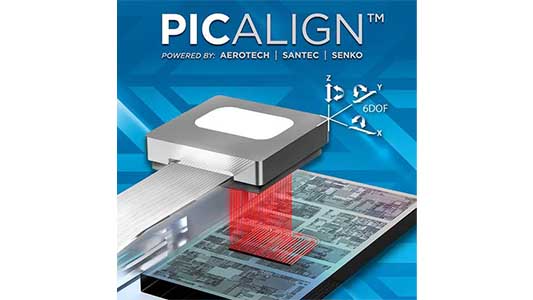
An integrated active alignment solution offers many benefits to the end-user performing alignments, which is why Aerotech launched PICAlign™, an active alignment solution collaboratively developed with SENKO and Santec.
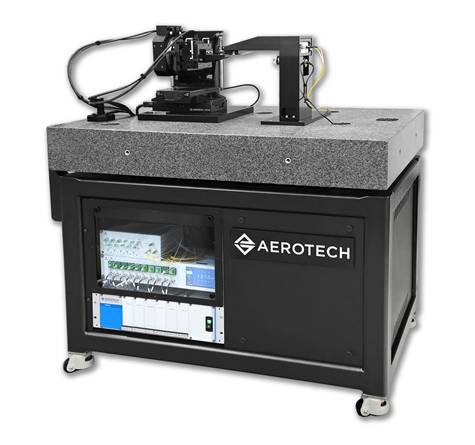
PICAlign is an integrated active alignment system for multichannel photonic devices that combines Aerotech’s motion control with Santec’s optical measurement instrumentation in a single platform. Designed to align these devices in seconds rather than the tens of seconds to several minutes legacy methods typically require, it reaches alignment within approximately 0.2 dB of the global optimum in under two seconds. Faster alignment translates directly into higher throughput, while better accuracy and repeatability translate into higher yield and less scrap. The system is engineered for reliability exceeding 30,000 hours MTBF in continuous production.
The commissioning difference is just as significant. A multi-vendor build requires separately sourcing and integrating motion control, light sources, and power meters — each from a different supplier, each requiring its own validation. PICAlign ships pre-integrated, tested together at Aerotech before it reaches the customer, which cuts commissioning time and removes much of the start-up uncertainty that comes with assembling a system from parts. It’s sold as a complete active alignment solution, including Santec’s hardware, which removes the burden of multi-vendor coordination from the customer entirely.
Can you walk us through what’s actually happening when PICAlign runs an alignment, and how does that scale as devices get more complex?

PICAlign moves the photonics devices relative to each other, coordinating motion in all degrees of freedom at once instead of working through them sequentially. At the same time, it monitors signal strength across every channel simultaneously — not just the outer loopback channels that legacy methods typically rely on, but the full set of channels on the device. That data builds a real-time, high-dimensional characterization of the search space: measuring power levels across all channels at once enables rapid multichannel optimization within that multidimensional space, in place of a series of isolated single-channel searches.
The system also supports custom objective functions — user-defined alignment conditions and power thresholds that let engineers prioritize the channels that matter most for a given application, such as polarization-maintaining fibers. The alignment process stops and returns to the identified optimum once a time limit is reached or threshold criteria are met.
Scaling isn’t as simple as “more channels take more time.” Tighter accuracy specifications inherently increase convergence time, but additional channels don’t necessarily slow the process down. Extra channels add more data to the search, which can actually speed convergence instead of hindering it. Where time genuinely accumulates is in aligning multiple separate devices one after another — the sequential nature of production, not the algorithm itself, is what adds up.
Why is multichannel alignment for detachable, expanded-beam connectors a particularly difficult case — and how does PICAlign address it?
Expanded-beam, detachable connectors were, in fact, the original driver behind PICAlign’s development. Their collimated beams make these devices highly sensitive to both angular and X/Y/Z misalignment simultaneously: expanded-beam optics ease linear alignment tolerances, but they typically demand tighter angular alignment in return. That makes this a genuine six-degree-of-freedom problem, where every axis matters and none can be treated as secondary.
PICAlign’s simultaneous, all-degrees-of-freedom approach was built to address exactly this case, and it scales further still — up to 12 degrees of freedom for compound alignments, such as configurations involving three devices with two in motion at once. Aerotech, Santec, and SENKO deliberately built PICAlign to work broadly across this class of problem, rather than for one narrow use case, on the shared view that solving alignment at an industry level benefits the ecosystem as a whole.
What does PICAlign take off a machine builder’s plate during equipment development?
With PICAlign, active alignment becomes a solved problem rather than something a machine builder has to re-engineer for every new piece of equipment. That frees engineering resources to focus on the machine builder’s own core competencies — epoxy dispense and curing, optical test, and the other processes that differentiate their equipment. The net effect is fewer variables to manage during development, and faster iteration on the parts of the machine that are genuinely theirs to build.
Is Asia-Pacific further along on this transition or facing it later — and where do you see active alignment headed next?
Asia-Pacific holds two overlapping ecosystems: a mature, well-established semiconductor manufacturing base and a younger CPO and photonics ecosystem that is still standardizing its supply chain. Taiwan in particular is a hotspot, with machine builders clustering near Taiwan Semiconductor Manufacturing Company (TSMC) and Outsourced Semiconductor Assembly and Test companies (OSATs) such as ASE Holdings (ASE). Aerotech has a long-standing presence across the region, alongside its established support in the US and Europe, and the market pressures playing out in CPO mirror what’s already familiar from semiconductor manufacturing — price, delivery, and throughput demands, all at once.
Where is active alignment headed next?
The near-term goal across the industry is to push alignment times under one second so that active alignment stops being a production bottleneck and becomes a fully solved step in the process. PICAlign’s current performance — already reaching approximately 0.2 dB of the global optimum in under two seconds — puts that goal largely within reach. Passive alignment continues to be explored and can address certain applications, but active alignment is expected to retain its role in test and assembly across the CPO ecosystem, particularly as channel counts continue to climb and the precision demands documented throughout this conversation become the industry norm rather than the exception.