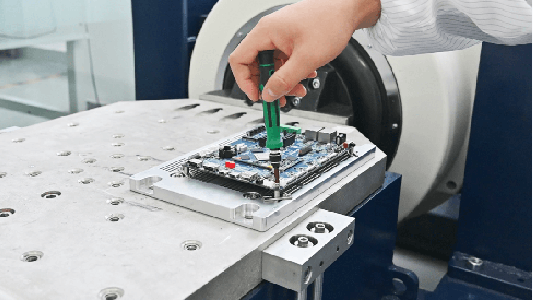

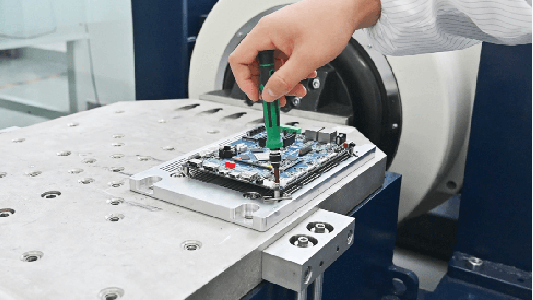
Aging tests are designed to run products continuously under simulated real-world workloads, accelerating the exposure of potential defects. For System-on-Modules (SoMs), this process is essential for identifying early-stage component failures—often referred to as the “infant-mortality” region of the bathtub curve.
During the 24-hour cycle, core components such as the CPU, GPU, NPU, memory, and eMMC are placed under sustained load. Continuous operation helps verify long-term stability, screens out weak components, and ensures consistent performance across production batches.

Why 24 Hours?
Electronic components tend to exhibit the highest failure rate at the beginning of their life cycle due to material or manufacturing variations. Statistical analysis shows that a 24-hour continuous run effectively captures this early-failure window while balancing test depth and production efficiency. Running SoMs at full capacity throughout the test helps expose hidden issues that would be difficult to detect through standard functional checks.

The Challenges Behind 100% Aging Tests
Performing a 24-hour aging test on every single SoM is far from simple. Key challenges include:
1. Time and throughput
A full day of testing adds significant time pressure to the production cycle. To maintain efficiency, the dedicated aging test workshop is essential for large-scale parallel testing and real-time scheduling.
2. Equipment and infrastructure investment
Professional aging racks, automated monitoring systems, environmental controls, and reliable power distribution represent substantial long-term investment—yet are essential for accurate and repeatable testing.
3. Technical expertise
Designing effective stress profiles, setting appropriate environmental parameters, and interpreting massive amounts of test data require deep engineering experience and practical knowledge.
Guaranteed Flexibility with Forlinx Embedded
Manufacturing, designing, and quality verifying – Forlinx Embedded guarantees every system on module is dependable from day one.
Forlinx Embedded provides 24-hour aging tests along with a series of strict tests such as signal integrity tests, high/low temperature tests, electromagnetic compatibility tests etc. for the lifetime of the boards and checked reliability under simulated real field.

The in-house manufacturing and laboratories are focused on high industry standard quality framework. “The 24-hour aging test is just one example of how we ensure every product meets our customers’ expectations,” the spokesperson added. “Reliability is the foundation of embedded systems, and Forlinx will continue to uphold rigorous standards throughout our development and manufacturing processes.”
In addition to modern seminar rooms and areas for testings and inceptions, a 31,000-square-meter area is available for R&D, Labs, and factory, with new SMT lines and control systems common in embedded engineering.