
By: Maurizio Di Paolo Emilio | Marcom Director | EPC


Gallium nitride (GaN) power technology is entering a new phase. After gaining traction in fast chargers, automotive power conversion, and other higher-voltage applications, GaN devices rated at 40 V and below are opening a new competitive front against silicon MOSFETs. According to Paul Pickering, Research Director at Omdia, low-voltage GaN could become one of the most disruptive developments in power semiconductors over the next several years.
Speaking on the GaN Talk podcast, Paul Pickering, Omdia Research Director, explained that the market opportunity is particularly significant because low-voltage GaN directly targets applications traditionally dominated by silicon. “Low-voltage GaN below 40 volts has the potential to be one of the most disruptive developments we’ve seen in recent years,” he said.
Why low-voltage GaN matters
The fundamental advantage of GaN is not limited to transistor-level performance. Higher switching frequencies can reduce the size of passive components, improve power density, and reduce system weight. These benefits become particularly valuable in battery-powered systems, where efficiency, size, weight, and operating time are closely connected.
Pickering highlighted drones as an important early application. Higher conversion efficiency can translate directly into longer flight times or increased payload. Humanoid robots are another emerging opportunity because multiple motor drives and power-conversion stages must operate within highly constrained mechanical spaces.
“From that standpoint, we expect that one of the first things that’s going to be affected is battery-powered applications, because size, weight, and battery life are all critical,” Pickering said. He also identified cordless power tools, e-bikes, and e-scooters as markets where low-voltage GaN could progressively gain ground.
The competitive landscape, however, may evolve beyond a simple GaN-versus-silicon comparison. Pickering expects integrated GaN power solutions—combining the transistor, driver, protection, and potentially control functions—to become increasingly important.
Low-voltage GaN and AI power delivery
Artificial intelligence is creating another major opportunity for low-voltage GaN. AI processors require extremely high currents at very low voltages, making conduction losses and switching performance critical.
Pickering pointed to the current generation of AI hardware, noting that “the latest NVIDIA devices are over 1000 amps at less than one volt.” At these current levels, even a small reduction in on-resistance can have a significant impact on power dissipation, energy efficiency, and cooling requirements.
The key parameters include RDS(on), input capacitance, and output capacitance. Lower RDS(on) reduces conduction losses, while lower input capacitance reduces the charge required during switching. Lower output capacitance can also reduce switching losses.
“For AI, small improvements in efficiency, one or two percent, result in a very large reduction in heat dissipated, in cooling costs, and in power consumption in general,” Pickering explained.
This makes low-voltage GaN particularly relevant to increasingly compact and high-current power architectures for AI computing.
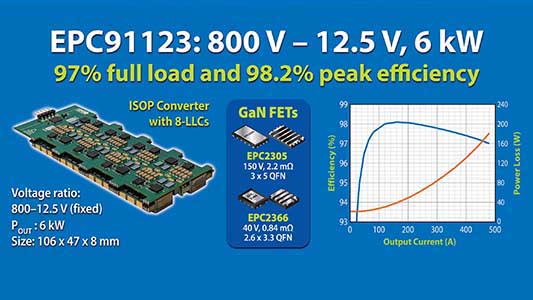
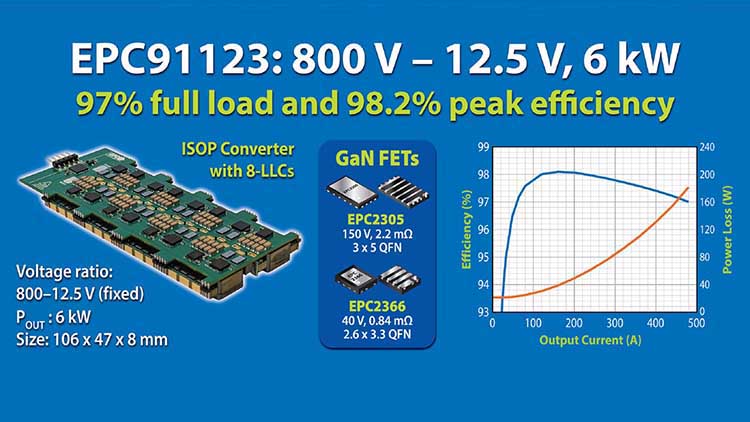
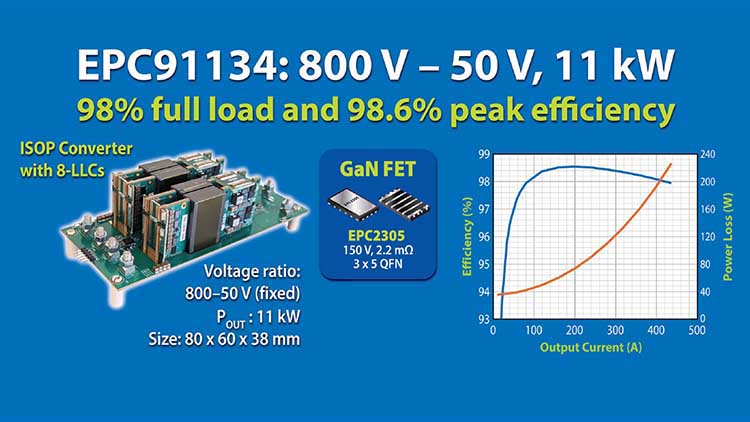
NVIDIA’s 800 V architecture could accelerate adoption
Pickering believes the transition toward new AI power architectures could significantly accelerate GaN adoption. He pointed specifically to NVIDIA’s announced 800 V power architecture as an important development.
“With recent announcements such as NVIDIA’s well-publicized 800-volt power architecture, that really raises the likelihood of early adoption of GaN,” he said.
Omdia expects GaN to become a preferred technology in performance-sensitive sections of AI power architectures over the next three to five years, particularly where efficiency, power density, and fast transient response are critical.
However, Pickering emphasized that adoption will not happen simply because GaN demonstrates superior electrical performance. Reliability and ecosystem maturity remain important barriers.
Data centers, in particular, require long-term reliability evidence. Rather than expecting existing installations to replace large numbers of power supplies, Pickering expects the biggest transformation to come from new data-center builds designed around emerging architectures from the beginning.
For low-voltage GaN specifically, he estimates approximately 40% year-on-year growth over the next several years, describing it as “certainly the hottest story in power development at the moment.”
Drones and humanoid robots could lead battery-powered adoption
Among battery-powered applications, drones appear particularly well positioned for early GaN adoption. Their business case is directly connected to energy efficiency: improved power conversion can increase flight time or payload.
Humanoid robots could follow as the technology develops. Battery-powered robots combine multiple motor drives, tight space constraints, and increasing demands for efficiency and power density.
Cordless power tools may adopt GaN more gradually. Silicon MOSFETs are already well established in this market, and users can easily replace batteries. However, Pickering noted that increasing electronic functionality—including Bluetooth and geofencing—will gradually increase power consumption, while physical constraints limit how much battery capacity can be added.
E-bikes represent another interesting opportunity because their design tradeoffs between efficiency, range, weight, and power density resemble those of electric vehicles.
The ecosystem may determine GaN’s next phase
For GaN to move beyond specialized applications and become mainstream, the industry must address more than semiconductor performance.
Pickering sees the development of a stronger design ecosystem as a major requirement. Silicon has benefited from decades of application knowledge, design tools, reference designs, and engineering experience. GaN designers, by contrast, must manage very fast rise and fall times, parasitic effects, high-frequency magnetics, and other design considerations.
“That is the challenge for GaN manufacturers: to develop that ecosystem,” Pickering said. “The big job that needs to be done by the industry, and especially low-voltage GaN because it’s the newest kid on the block, is developing the ecosystem that makes it easier for people who are not necessarily experts in GaN design to use it.”
Integration will also play an important role. The market is moving from standalone GaN transistors toward integrated power ICs that combine power devices with gate drivers, protection, and control functions. Such integration can reduce design complexity and lower the barrier to adoption, particularly for customers purchasing through distribution rather than working directly with semiconductor manufacturers.
EPC and the ecosystem needed for low-voltage GaN
Pickering sees EPC as one of the companies that could play an important role in accelerating low-voltage GaN adoption. He specifically points to EPC’s position in low-voltage GaN and the company’s role in addressing one of the industry’s biggest challenges: making GaN easier to design with.
“Since EPC is leading in the low-voltage GaN, I think they will be a key part of what’s going on over the next five years,” Pickering said.
For Pickering, however, leadership in device performance is only part of the equation. The broader challenge is creating an ecosystem that allows engineers accustomed to silicon MOSFETs to adopt GaN without having to become GaN specialists.
“Silicon MOSFETs have been around for 50 years. The ecosystem around silicon is very well understood,” he explained. “That is the challenge for GaN manufacturers: to develop that ecosystem because, let’s face it, as you know very well, GaN for somebody who’s used to designing with silicon is a little bit tricky.”
He highlighted the very fast rise and fall times of GaN devices, which make parasitics, layout, and high-frequency magnetics increasingly important considerations for designers.
According to Pickering, EPC and other GaN manufacturers therefore have an opportunity to lower the design barrier, particularly for the large number of customers that do not have direct relationships with semiconductor manufacturers.
“I think there’s a big job that needs to be done by the industry, and especially low-voltage GaN because it’s the newest kid on the block, developing the ecosystem that makes it easier for people who are not necessarily experts in GaN design to use it,” he said.
Integration is another area where Pickering sees EPC and the wider GaN industry making progress. The market is moving from standalone GaN transistors toward integrated power solutions that combine the power device with gate drivers, protection, and potentially control functions.
“That reduces design complexity, and it lowers the barriers to adoption for customers who may not be experts in GaN,” Pickering said.
He also stressed that this ecosystem is particularly important beyond the largest semiconductor customers. While major power-supply manufacturers can work directly with semiconductor companies, a much larger population of engineers purchases through distribution and may design relatively modest volumes of products.

For these customers, reference designs, application support, integrated devices, and accessible design information could be as important as the underlying transistor performance.
From high-performance alternative to mainstream technology
Looking toward the end of the decade, Pickering expects GaN to evolve from a relatively specialized high-performance alternative into a mainstream power semiconductor platform.
“GaN is right now a sort of a slightly exotic high-performance alternative, and I think GaN has to move, and I expect it to move, to being a mainstream power semiconductor platform across multiple markets,” he said.
Highly integrated GaN power ICs could become an important part of this transition. Pickering also sees increasing combinations of GaN and silicon, with GaN handling power delivery and protection while silicon continues to provide certain control functions.
Further ahead, vertical GaN could expand the technology’s reach into higher-voltage applications and potentially bring GaN into closer competition with silicon carbide.
The broader trend is therefore clear: low-voltage GaN is expanding the addressable market for the technology, while AI power delivery, drones, humanoid robotics, e-mobility, and increasingly integrated power solutions are creating new adoption opportunities. As Pickering summarized, “We are just starting to see GaN become accepted, widely accepted as an alternative to silicon MOSFETs. As I said, starting with the higher-efficiency critical applications, and then eventually I expect it to move down into being a broadly well-accepted and well-understood technology for pretty much every power semiconductor application.”
About the author:

Maurizio Di Paolo Emilio holds a Ph.D. in Physics and is a Telecommunications Engineer. He is Director of Global Marketing Communications at EPC (Efficient Power Conversion), where he manages worldwide initiatives to showcase the company’s GaN innovations. He is a prolific technical author of books on GaN, SiC, energy harvesting, and data acquisition and control systems, and has extensive experience as an editor for technical magazines and online publications in power electronics, wide bandgap semiconductors, and embedded systems.