



Electronics Era : Alif Semiconductor is known for its Ensemble and Balletto MCUs. What technical innovations differentiate these products in a crowded microcontroller market?
Reza : Alif’s Ensemble and Balletto MCUs stand out because they are designed from the ground up for edge AI.
Our leadership in this space began in 2021, when we were first to market with silicon that includes the Arm Ethos-U55 NPU, as seen in our Ensemble family. We then introduced the Balletto family, which builds off the well-known Ensemble architecture by adding on BLE wireless capability. That early experience has directly shaped our new generation of Ethos-U85-based devices, allowing us to stay well ahead of competitors.
In our latest designs, we integrate up to three NPUs so the system can dynamically apply the right compute resources for each task, maximizing power efficiency. The architecture includes an ultra-low-power, always-on region with dedicated memory and interfaces to continuously gather data from sensors, whether it is vision, voice, or vibration, and perform meaningful initial analysis locally. Only when necessary, do other regions of the chip wake to handle more demanding workloads, such as heavy ML inference on additional CPU/NPU pairs accelerated by the Ethos-U85, before quickly returning to a low-power state.
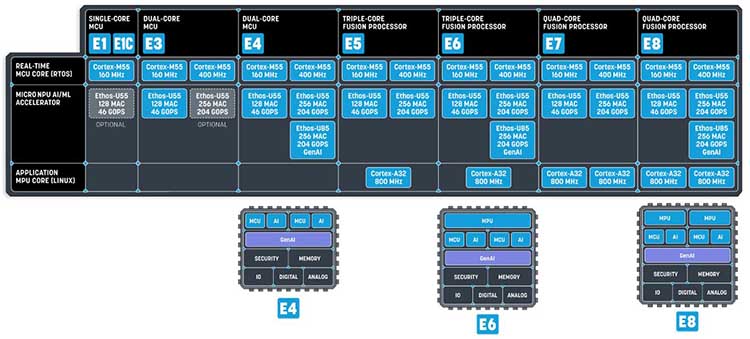
This high-performance domain is built with the exact capabilities our target markets require, informed by years of real-world customer feedback. We lead in on-chip memory capacity in this class of device, offer a tiered approach for fast access to external memory, deliver powerful image and audio processing, enable rich graphics for displays, support high-speed interfaces, and handle complex analog signals. All of this is orchestrated by a granular power management system that automatically powers up or down specific sections of the chip based on real-time workload.
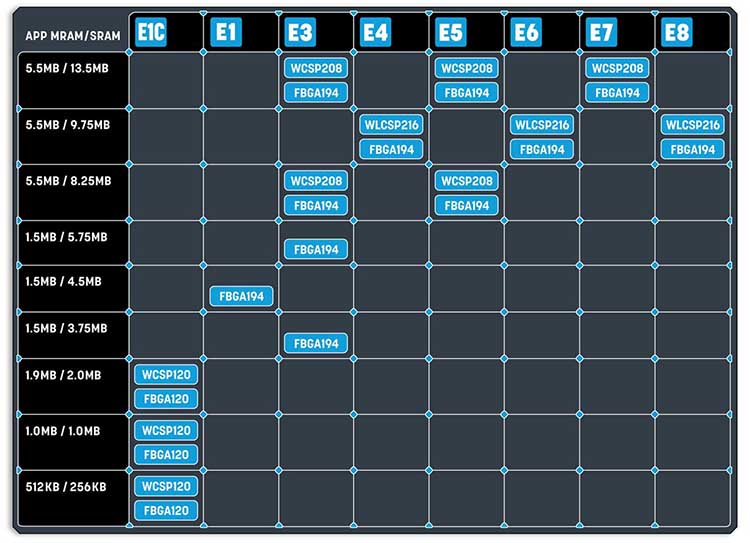
These innovations are not locked into a single product. They are deployed across a scalable range of MCUs and fusion processors within the Ensemble family, with software compatibility spanning 19 previous U55-based Ensemble devices and hardware footprint compatibility with eight existing products in the BGA194 package. This means developers can upgrade to Ethos-U85 performance without redesigning their circuit boards and while reusing their existing software.
The combination of long battery life, unmatched architectural efficiency, and a deliberate, compatible product evolution is what sets Alif apart in the crowded MCU market. This is the direct outcome of our first-to-market advantage and years of innovation in edge AI.

Electronics Era : How does Alif’s use of heterogeneous compute (combining Cortex-M55 and Ethos-U55, and now the Ethos-U85) enhance edge AI performance compared to competitors?
Reza : Alif’s use of heterogeneous compute is purpose-built to push edge AI further than competitors can. While others may simply bolt an NPU onto an MCU, Alif designs the entire architecture so that Cortex-M55 CPUs, multiple Ethos-U55 cores, and now the Ethos-U85 cores work in concert (Hint: this is where the name Ensemble comes from!).This allows us to run AI workloads in tiers, with always-on, low-power sensing and inference for voice, vision, or vibration in one region of the chip, and the ability to instantly wake higher-performance CPU and NPU pairs for intensive tasks, then shut them back down to save power.
The competitive edge comes from how seamlessly we manage this transition between “listen and detect” mode and “heavy AI processing” mode. Our larger on-chip memory, optimized data pathways, and high-speed multimedia interfaces mean AI workloads stay on-device, process faster, and consume less energy. Because we have built these capabilities into a fully compatible Ensemble product family, developers can adopt the latest Ethos-U85-based devices without reworking hardware or software, which accelerates time-to-market for next-generation edge AI solutions while competitors are still adapting their designs.
Electronics Era : What role does embedded AI play in your product roadmap, and how is Alif positioning itself to lead in this area over the next 5 years?
Reza : Edge AI is not just part of Alif’s roadmap; it is the driving force behind it. We see a future where intelligence is no longer confined to the cloud, but is built directly into the smallest, most power-conscious devices. That shift will transform how billions of products operate, from wearables and industrial sensors to healthcare devices, enabling them to think, decide, and act instantly wherever they are.
Our approach is to engineer MCUs that are purpose-built for AI at the edge, rather than adapting legacy designs. This means integrating multiple NPUs, optimizing every subsystem for ultra-low power operation, and building hardware acceleration for advanced AI models such as transformers. By doing this, we make it possible to run sophisticated workloads entirely on-device, cutting latency to near zero, keeping data secure, and enabling use cases that simply cannot wait for the cloud.
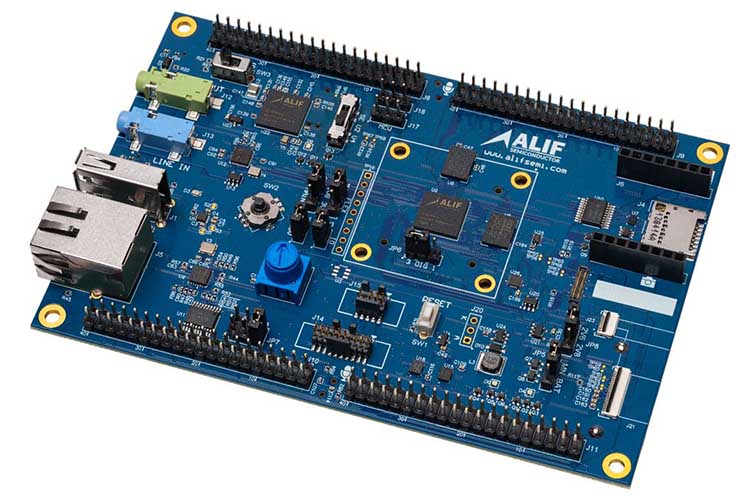
In addition, just as developers steer clear of CPUs with proprietary instruction sets to avoid being tied to closed ecosystems with limited tools, we believe that adopting widely used NPU architectures will open up more options for developers and encourage ecosystem partners to invest in building robust support. A shared architecture means their innovations can reach a broader audience, making that investment more worthwhile. Every Alif product is built to be scalable, with full software compatibility across the board and full pin compatibility across many products, so developers can easily transition to more powerful devices in the future without disrupting their workflow or redesigning their hardware.
In the next five years, we plan to continue to expand this capability across a scalable product family that gives developers a consistent, open, and forward-compatible platform to innovate on. For us, edge AI is not an optional feature or a short-term trend, it is the foundation for the next generation of intelligent systems, and Alif intends to lead that evolution.
Electronics Era : How does Alif handle chip security (e.g., secure boot, key provisioning, secure enclaves) at the silicon level?
Reza : Security, scalability, power efficiency, and AI readiness are all built into the DNA of the Alif Ensemble family. Every device in the lineup integrates a full secure enclave, including a Root of Trust, a unique device ID, a dedicated security processor, protected memory, and configurable firewalls. These firewalls control CPU access to specific memory regions and peripherals, extending the capabilities of standard Arm TrustZone security for even stronger system protection.
This multi-layered security approach is managed by an independent, isolated security subsystem that enforces policy across the entire device, ensuring robust protection for sensitive applications. On the processing side, the Ensemble family scales from single-core MCUs to quad-core fusion processors that combine MCU and MPU cores, giving developers flexibility to match performance to the needs of each design.
All of this is delivered with an architecture that is exceptionally battery-friendly, designed for the lowest possible power consumption without compromising capability. And with dual Arm Ethos-U55 NPUs, plus the latest addition of the Ethos-U85 NPU, Ensemble devices are ready for edge AI, enabling fast time-to-inference for advanced AI and machine learning workloads. This combination of deep security, flexible performance, low power, and AI acceleration is what sets Alif apart in the microcontroller market.
Electronics Era : What is Alif’s approach to long-term support and scalability in industrial and automotive sectors, where product lifecycles can exceed 10 years?
Reza : Alif has a longevity program that guarantees availability for at least 10 years from when a request to have a product included in the program is approved.
Electronics Era : How does Alif integrate with major AI/ML software frameworks (e.g., TensorFlow Lite for Microcontrollers), and what partnerships are key to your ecosystem?
Reza : From the initial introduction in 2021, deploying TFLite models on Alifs Ensemble and Balletto devices has been very straightforward. The model must be quantified to use int8, but once that is done the tool, known as the Vela compiler, that converts the models to a format that the NPU can execute will handle the rest. Alif is also working actively with Meta and Arm on enabling a similarly straightforward path for deploying PyTorch models on the ExecuTorch runtime, look out for more details on this in the coming months.