

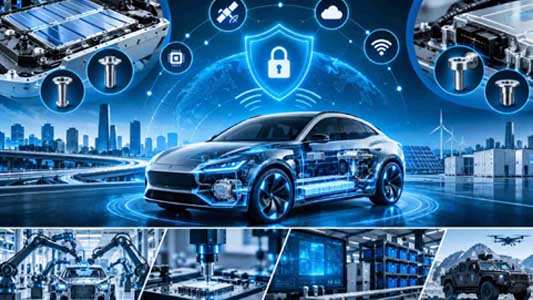
India’s automotive industry is entering a connected era. Modern cars increasingly combine connected infotainment, telematics, advanced driver-assistance systems (ADAS), over-the-air software updates, sensors and high-voltage electric powertrains. This connectivity brings new capabilities-but also expands the vehicle’s cybersecurity attack surface.
Why Automotive Cybersecurity Matters
A connected vehicle is no longer an isolated mechanical product. It is a cyber-physical system, where software, electronics, communications and physical components must work together reliably. A compromised communication interface could potentially affect vehicle functions, data security or operational safety.
For Indian vehicle manufacturers, cybersecurity therefore needs to be considered throughout the product lifecycle-from engineering and component selection to manufacturing, assembly, testing and after-sales support.
Where Fastening Technology Fits In
Cybersecurity is primarily associated with software, but physical security remains an important part of vehicle engineering. Battery enclosures, electronic control units, sensor assemblies, power electronics and other critical systems depend on reliable mechanical fastening.
For EV applications, Bossard highlights requirements such as durability, vibration resistance, temperature resistance and reliable clamp loading. Its EV fastening portfolio includes threaded inserts, multifunctional screws, seals and nut/washer assemblies for applications such as battery systems and busbar assemblies.
Correct fastener selection, joint design, tightening and validation can therefore contribute to the mechanical integrity of systems that support connected vehicle functions.

Engineering and Smart Manufacturing: A Connected Approach
Cybersecurity also needs to extend into the manufacturing environment. Engineering services, fastening strategy, testing and digital assembly solutions can help manufacturers identify risks before they become production problems.
Bossard’s Expert Design services support fastening strategy, joint design, validation and design optimization, while its testing services provide laboratory-based evaluation of mechanical fasteners and fastening joints.
On the factory floor, Smart Factory solutions can provide greater transparency in C-parts and assembly logistics. Bossard’s Smart Factory Logistics portfolio includes connected systems such as SmartBin Cloud and SmartLabel Cloud for digital inventory and material-flow management.
Key Priorities for Connected Vehicles
• Secure electronic architectures across connected vehicle systems.
• Reliable fastening for batteries, sensors, electronics and structural assemblies.
• Validated joints capable of handling vibration, temperature and operating loads.
• Traceable manufacturing processes and controlled component supply.
• Engineering-led design validation before production.
• Digitized assembly and inventory management to improve manufacturing visibility.
Looking Ahead
As Indian vehicles become more connected, automotive cybersecurity will increasingly require cooperation between software, electronics, mechanical engineering and manufacturing teams. The objective is not simply to protect data-it is to build vehicles in which digital intelligence and physical reliability work together.
For automotive and EV manufacturers, Bossard combines fastening technology, engineering expertise, testing capabilities and Smart Factory solutions to support reliable and efficient vehicle production.
Explore More
Discover Bossard’s automotive and EV fastening, engineering and Smart Factory solutions for connected vehicle manufacturing.