



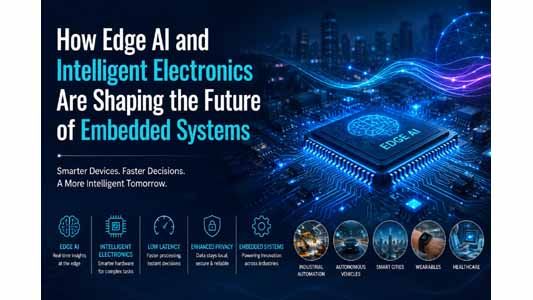

The Evolution of Embedded Systems in the Age of Edge AI
Embedded systems have become the basic unit of modern electronics in such devices as household appliances, wearables, and even industrial automation equipment and self-driving cars. Traditionally, such systems have utilized the capabilities of centralized cloud computing for data processing and decision-making. But with an increased need for instant response, more secure solutions and lesser network dependency, the use of Edge Artificial Intelligence (AI) is rapidly growing. By performing data processing directly at the embedded system level, Edge AI reduces latency and minimizes the use of bandwidth. Due to the integration of intelligent electronics with sophisticated sensors, processors, and networking features, embedded systems are transforming themselves into more effective and autonomous entities that are able to perform tasks independently without needing continuous cloud connectivity. This development is having an impact on various industries by making analytics faster, providing predictive maintenance, creating more personalized user experience and increasing energy efficiency of electronics. The increased accessibility of computing power means that with the combination of intelligent electronics with Edge AI, embedded systems will be used more and more in the future. According to Consegic Business Intelligence, the global Edge AI Hardware Market is projected to grow from USD 26.12 billion in 2024 to over USD 190.83 billion by 2032, expanding at a CAGR of 21.52%. This explosive growth is fuelled by the increasing proliferation of intelligent edge devices capable of executing AI workloads at the edge powering the next generation of embedded systems in industry.
Understanding Edge AI and Intelligent Electronics
Edge AI involves using artificial intelligence algorithms directly on edge devices so that the devices can be able to analyse and perform intelligent tasks on their own rather than processing the data on cloud servers located remotely. Edge devices include smartphones, industrial controllers, medical devices, security cameras, and Internet of Things (IoT) sensors. Smart electronics provide better efficiency through integration of powerful microprocessors, AI accelerators, advanced memory and smart sensors in small form factors. Embedded systems can thus be able to interpret data, detect patterns and make decisions almost immediately using the combined hardware components. Unlike conventional embedded systems which follow pre-coded instructions, AI-based embedded systems are constantly learning from the data and adjusting to new circumstances. This feature allows the systems to become accurate, responsive and automated in all situations. Thanks to improvements in semiconductor technology, low-power AI processors and machine learning frameworks, it has become easier to apply Edge AI in embedded devices with low computational power. It is therefore possible for device manufacturers to produce devices which are highly efficient yet consume very little power and are reliable.
Key Benefits of Integrating Edge AI into Embedded Systems
The integration of Edge AI into embedded systems is accompanied by many positive aspects that positively impact the performance and the intelligence of electronic devices. The first major benefit is the ability to provide real-time decision-making because the processing is done right on the device and does not take time for information exchange with cloud servers. Low latency processing is especially needed for technologies such as autonomous vehicles, industrial robots, or medical monitoring tools. Furthermore, Edge AI provides enhanced data privacy and protection since all the data is kept right on the device and does not travel through any networks, which decreases the vulnerability to cyber-attacks and other types of hacking. In addition, there is a lower bandwidth consumption since the system sends only valuable insights or processed data to the cloud. Edge AI also allows the systems to work even in places where there is no connection with the Internet. Finally, modern AI processors can operate efficiently using low amounts of power, thus allowing battery-powered devices like wearables or IoT sensors to perform intelligent functions.
Real-World Applications Across Industries
The integration of Edge AI and intelligent electronics has revolutionized the embedded systems in different industries through providing faster, smarter, and autonomous services. By processing data in real-time, the automotive industry has used Edge AI to develop advanced driver assistance systems, such as lane departure warning, collision avoidance, and pedestrian detection. In the field of healthcare, intelligent electronics and Edge AI have allowed continuous monitoring of the vital signs of patients in wearable and portable medical equipment that detect any abnormalities and send immediate notifications without needing the connection to the cloud. There are many advantages of the integration of AI in industrial manufacturing such as predictive maintenance, quality inspection, and intelligent robotics that help in minimizing downtime and increasing production efficiency. The intelligent embedded devices in smart homes include voice assistants, surveillance cameras, and energy management systems that provide personalized services and improve privacy with the help of Edge AI. Another area that uses the integration of intelligent electronics and Edge AI includes agriculture, where the use of AI sensors in embedded devices monitors soil conditions and helps in the optimization of irrigation and crop disease detection.
Challenges and Considerations in Edge AI-Based Embedded System Design
Despite the above-stated benefits, incorporating Edge AI into the process of developing embedded systems raises multiple technical and operational issues. The first issue is the limited number of computational capabilities available on embedded devices in terms of processing power, memory, and storage. It is necessary to create an efficient optimization of AI models to provide correct results under the above-stated conditions. Moreover, it is vital to consider the power consumption as the issue. In the case of wearable and remote IoT devices, battery lifetime is a vital characteristic, which makes power consumption an important aspect. Cybersecurity is another crucial concern because the above-stated systems can become an object of a cyber-attack. It is necessary to develop mechanisms of security to protect the above-stated devices from various types of cyber threats. Finally, it is important to guarantee the correctness of the results provided by AI model over time. Regular updates and re-training will be required in order to maintain the model up-to-date.
The Future of Embedded Systems: Emerging Trends and Innovations
The future trends of embedded system technology development include constant progress in the field of Edge AI, intelligent electronics, and future semiconductor technologies. The future of embedded systems will include increased efficiency of AI models that allow doing increasingly complicated tasks using minimum amounts of power. The increasing availability of 5G and future 6G technology networks will allow increasing the effectiveness of edge computing with higher speeds, less latency, and easy connection between the smart devices. Some new technologies like TinyML allow to deploy ML models directly to the microcontrollers and make the usage of AI models possible even for resource-constrained embedded systems. Neuromorphic computing and special hardware accelerators that optimize the process and can think and act as people do will be a part of future embedded systems. The future systems will become more autonomous as they will be able to learn, do preventive maintenance, and adapt their behavior depending on the circumstances. With the growth of the focus on sustainable environment and sustainable development, energy-efficient electronics will be a trend of the future.
Conclusion
The advent of edge AI and intelligent electronics has been instrumental in transforming the capabilities of embedded systems by bringing in speed, intelligence, and security in the process of data handling within the device itself. This not only addresses the issues of latency, privacy, energy consumption, and real-time decision making but is useful in diverse industries ranging from healthcare, automotive, manufacturing, agriculture, and smart homes. While issues pertaining to hardware constraints, energy utilization, and security persist, continuous developments in the domain of AI hardware, semiconductors, and network communications are ensuring fast-paced innovation. The future of embedded systems lies in the technologies of TinyML, 5G, and AI accelerators.
About the Editor

Aditi Jaiswal, aditi.j.reportsinsights@gmail.com
Aditi Jaiswal is a content writer at Consegic Business Intelligence a strong foundation in creating meaningful and engaging content. She covers a range of subjects related to technology, digital ecosystems, and latest trends in such a way that every article she pens down comes with great clarity and depth. She specializes in offering highly-focused, research-driven articles that not only inform but also intrigue her audience.