


Automated Optical Inspection (AOI) and Automated X-Ray Inspection (AXI) are the backbone of quality control in SMT manufacturing. According to IPC, market demand is projected to grow from approximately $534 billion in 2023 to $856 billion by 2030. However, this rapid growth is accompanied by a severe labor crunch, with the US alone risking a technician shortage reaching 90,000 by 2030.
As component sizes shrink (0201/01005) and densities increase, conventional rule-based algorithms are reaching their limits. The challenge for quality teams is therefore clear: How can First Pass Yield (FPY) at the inspection stations be maximized without compromising inspection reliability in accordance with IPC-A-610?
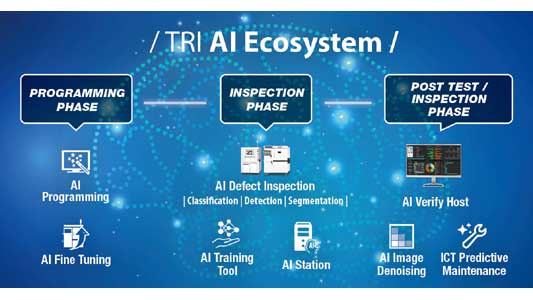
This is precisely where a paradigm shift is currently taking place. Inspection solution providers such as Taiwanese specialist Test Research, Inc. (TRI) are increasingly focusing on integrated AI ecosystems. The approach goes far beyond simple image pattern recognition: Artificial intelligence can support the entire inspection cycle—from offline program generation and primary inspection to centralized result verification.
Reducing NPI Effort: The Benefits Start Before Inspection
Especially in High-Mix environments with frequent product changes and New Product Introductions (NPI), programming AOI and AXI systems can represent a significant bottleneck. Modern software solutions address this through autonomous learning functions.
AI Fine Tuning focuses on automatically adjusting specific inspection parameters to ensure the hardware captures the highest quality data. This fundamental shift allows a Junior Engineer to execute complex setups in a fraction of the time, achieving high-accuracy results that once took years of experience to master. In an extensive AXI case study across four distinct board configurations, AI Fine Tuning delivered total programming time reductions ranging from 22% for an 88-package board to 42% for a 57-package board. Furthermore, to mitigate cybersecurity risks, large EMS manufacturers often opt to install these AI servers on-site, ensuring data remains securely within the premises.
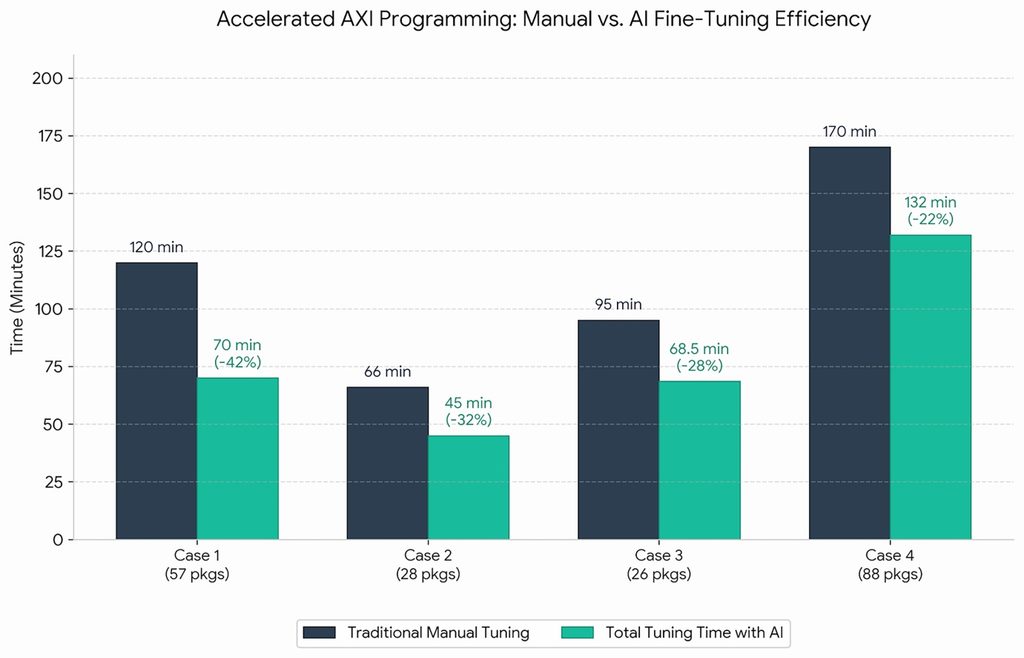
[Accelerated AXI Programming Bar Chart]
Light and Shadow: Pixel-Level Optical and Hidden-Joint Inspection
Conventional algorithms often struggle to interpret complex grayscale images when PCB thicknesses vary or solder joints are hidden beneath BGA, QFN, or LGA components. To tackle this, advanced AXI systems utilize multi-model AI architectures that scan images at the pixel level:

- AI Detection: Scans the X-ray image to rapidly identify regions of interest. The AI detection accuracy for general chip defects now exceeds 99%, with specific components like SOD and SOT23 exceeding 95%.
- AI Segmentation: Traces the exact contours of a void or a solder bridge. X-ray void detection with AI implementation improves the first pass yield (FPY) rate from 85% to 98%.
- AI Classification: Categorizes the shape as a true defect or false call. For complex components like the Paladin connector, AI classification reduces the false case rate from approximately 25,000 ppm to around 3,000 ppm, an 88% improvement.
- AI Denoising: Filters out noise caused by structures like heatsinks or low contrast, sharpening the image to make defects more noticeable for operators.
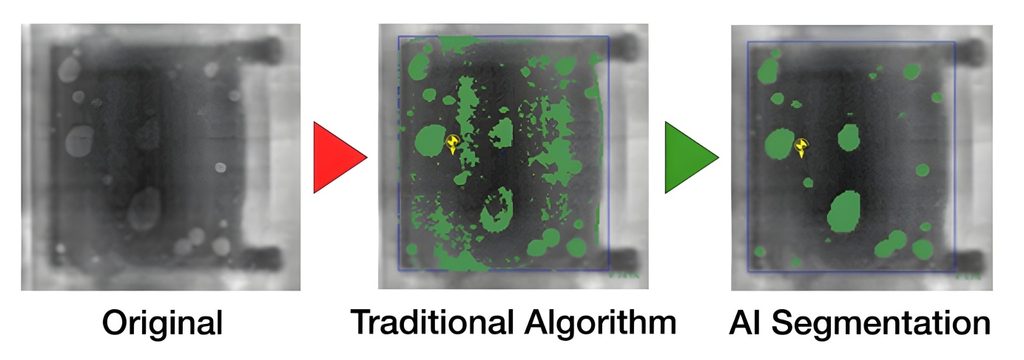
[Traditional vs. AI Segmentation Image]
The Human at the Interface: From Sorter to Decision-Maker
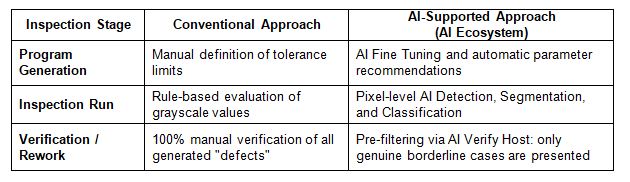
A common misconception is that AI makes operators obsolete. In reality, it acts as a highly sophisticated filter. Operating as an intelligent repair station, the AI Verify Host automates the manual “Buy-Off” process. The interface provides real-time board information, hourly data trends, and a direct visual comparison between the flagged component and a “Golden” standard. Component statistics are further categorized by Machine Defect, AI Defect, and Confirm Defect, granting production managers granular visibility into yield metrics.
By drastically reducing false alarms and automating parameter optimization, the system cuts operator workload to a fraction of traditional levels. This efficiency allows a single operator to confidently manage multiple inspection lines simultaneously, successfully creating a highly efficient “1-person, 2-line” control center model. Continuous optimization through this system has been shown to yield a 10% increase in the final yield rate.
From Inspection Station to a Closed-Loop Process
For production managers, the future lies in connecting quality data across the entire SMT line. When data from solder paste inspection (SPI), placement, post-reflow AOI, and AXI inspection are brought together within a Yield Management System (YMS 4.0) utilizing IPC-HERMES-9852 and IPC-CFX standards, AI enables process optimization:
- Early detection: If post-reflow AOI detects a systematic shift of a specific component, AI can report this back to the placement machine.
- Process-window adjustment: If solder paste volumes begin to drift, feedback can be sent to the printer.
- Root-cause analysis: Connected algorithms identify whether a voiding issue detected by AXI is attributable to an incorrect reflow profile or an inadequate solder paste deposit.
Conclusion & Outlook for Management
Integrating AI-driven inspection represents a new frontier in quality control, enabling manufacturers to keep pace with the increasing complexity of modern electronics. The industry must embrace this technology to fully realize its potential against the ongoing labor shortage. When evaluating AI ecosystems, decision-makers should look beyond laboratory detection rates to actual time savings during NPI, false-call reductions under real production conditions, and seamless MES integration.
Meet the Experts at electronica 2026
At the upcoming electronica 2026 in Munich (November 10–13, 2026), you can meet the specialists from Smartlink-SMT directly at the booth of our partner Test Research, Inc. (TRI) in Hall A4, Booth 638.
To learn more about TRI’s AI-driven inspection solutions, visit www.tri.com.tw.